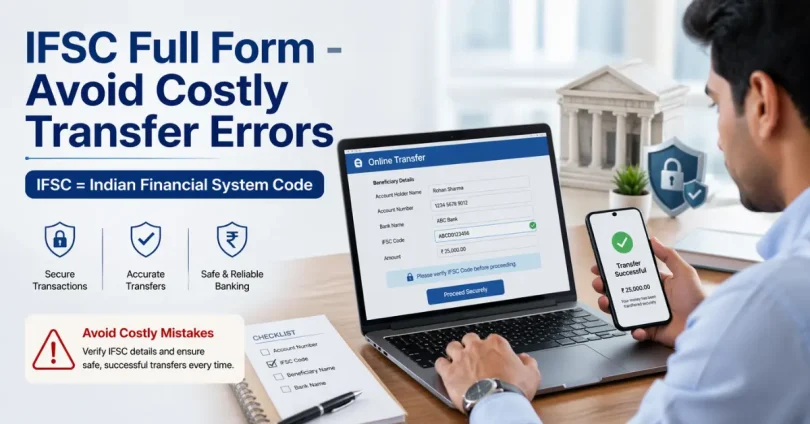

IFSC Full Form
IFSC stands for Indian Financial System Code. It is an 11-character code used to identify a specific bank branch in India for online money transfers.
| Short Form | IFSC |
|---|---|
| IFSC Full Form | Indian Financial System Code |
| Code Length | 11 Characters |
| Code Type | Alphanumeric |
| Used For | NEFT, RTGS, IMPS, and online bank transfers |
| Example | SBIN0000738 |
The IFSC full form is Indian Financial System Code. It is an 11-character alphanumeric code used to identify a specific bank branch in India during online money transfers.
Whenever you send money through NEFT, RTGS, or IMPS, the IFSC code helps the banking system route the money to the correct bank branch. In simple words, it works like a digital address for a bank branch.
If you use online banking, mobile banking, or payment apps, understanding the IFSC full forms and its use can help you avoid failed transactions, delays, and wrong transfers.
Table of Contents
What Is an IFSC Code?
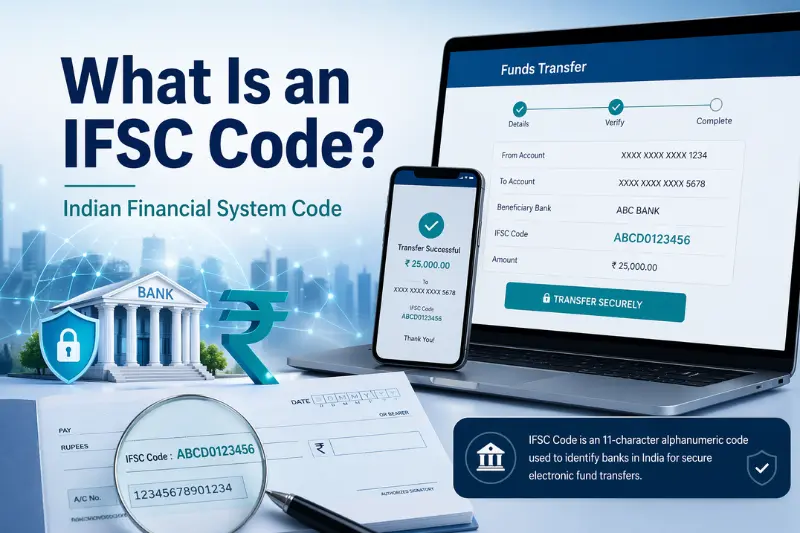
An IFSC code is a unique code given to each bank branch that participates in India’s electronic payment system. The IFSC full form clearly explains its purpose: it is a financial system code used in India.
Every bank branch has a different IFSC code. For example, one State Bank of India branch in Delhi will have a different IFSC code from another SBI branch in Mumbai.
This makes online banking more accurate because the system can identify the exact branch where money should be sent.
Why Is IFSC Code Important?
The IFSC code is important because it helps banks transfer money safely and correctly.
Here are the main reasons why it matters:
- It identifies the correct bank branch.
- It helps process NEFT, RTGS, and IMPS transactions.
- It reduces the risk of failed or delayed payments.
- It helps banks verify transaction details.
- It supports paperless and digital banking.
- It helps track transactions in case of disputes.
Without the correct IFSC code, your online transaction may fail, get delayed, or require manual correction by the bank.
IFSC Code Format Explained
An IFSC code has 11 characters. It is not a random code. Each part has a specific meaning.
Example: SBIN0000738
| Part | Meaning | Example |
|---|---|---|
| First 4 characters | Bank code | SBIN |
| 5th character | Always 0 | 0 |
| Last 6 characters | Branch code | 000738 |
In this example:
- SBIN represents State Bank of India.
- 0 is reserved for future use.
- 000738 identifies the specific branch.
This structure makes it easy for the banking system to recognize both the bank and the branch.
How Does IFSC Code Work?
When you transfer money online, the bank needs three main details:
- Receiver’s account number
- Receiver’s name
- Receiver’s IFSC code
The IFSC code tells the system which bank branch should receive the money. After the branch is identified, the account number helps deposit the money into the correct account.
Here is the simple process:
- You enter the recipient’s account details.
- You add the IFSC code.
- The bank checks the IFSC code.
- The system identifies the correct branch.
- The money is routed safely.
- The transaction is completed.
This is why entering the correct IFSC code is very important.
Uses of IFSC Code
The IFSC full form is mostly searched by people who want to understand online banking. But the code is used in many real banking activities.
1. NEFT Transfers
NEFT stands for National Electronic Funds Transfer. It allows you to transfer money from one bank account to another across India.
NEFT transactions are processed in batches. For NEFT, the recipient’s IFSC code is required.
2. RTGS Transfers
RTGS stands for Real Time Gross Settlement. It is usually used for high-value transactions.
RTGS transfers are processed individually and in real time. The IFSC code helps route the payment to the correct bank branch.
3. IMPS Transfers
IMPS stands for Immediate Payment Service. It allows instant money transfers, usually available 24/7.
When you send money through IMPS using account details, the IFSC code is required.
4. Adding a Bank Beneficiary
When you add a new beneficiary in net banking or mobile banking, you usually need the account number and IFSC code.
5. Receiving Payments
Freelancers, businesses, employees, and service providers may share their account details with IFSC code to receive payments directly into their bank account.
Where Can You Find Your IFSC Code?
You can find your IFSC code in several easy ways.
1. Cheque Book
The IFSC code is usually printed on the cheque leaf near the bank branch details.
2. Bank Passbook
Most banks print the IFSC code on the first page of the passbook along with account and branch details.
3. Bank Statement
Your monthly or digital bank statement may include your branch IFSC code.
4. Mobile Banking App
You can open your bank’s mobile app and check account details. Many banks show the IFSC code inside the account information section.
5. Net Banking Portal
Log in to your bank’s official net banking website. Your IFSC code may appear in profile, account summary, or branch details.
6. Official Bank Website
Most banks have a branch locator tool. You can search by state, city, and branch name to find the correct IFSC code.
7. RBI Website
The Reserve Bank of India also provides IFSC-related information for bank branches.
Can You Find The IFSC Code Using The Account Number?
Usually, you cannot directly find an IFSC code only from an account number.
An account number identifies your bank account, while the IFSC code identifies your bank branch. Both are different details.
However, your bank can help you confirm the IFSC code if you provide your account details through official banking support.
Is It Safe to Share IFSC Code?
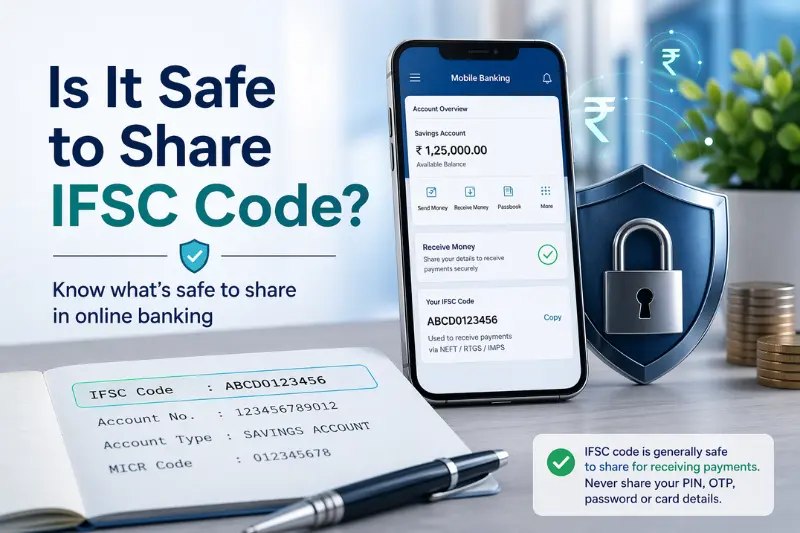
Yes, it is generally safe to share your IFSC code. The IFSC code alone cannot be used to withdraw money from your account.
People often share IFSC codes to receive payments. However, you should still be careful with your full banking details.
You can share:
- Account holder name
- Account number
- IFSC code
But never share:
- OTP
- ATM PIN
- Debit card PIN
- Net banking password
- UPI PIN
- CVV number
A genuine sender only needs your account number, name, and IFSC code to send you money.
What Happens If You Enter the Wrong IFSC Code?
If you enter the wrong IFSC code, a few things may happen:
- The transaction may fail.
- The money may return to your account.
- The transfer may get delayed.
- The bank may ask for a correction.
- In rare cases, the payment may need manual support.
To avoid problems, always double-check the IFSC code before confirming a transfer.
Does the IFSC Code Change?
Yes, an IFSC code can change in some cases.
This may happen when:
- A bank branch is merged.
- A bank is renamed.
- A bank merger takes place.
- A branch is closed.
- A branch is shifted or restructured.
For example, after bank mergers, some old IFSC codes may become inactive. That is why you should always verify the latest IFSC code from your bank’s official website, mobile app, passbook, or RBI source.
IFSC Code and UPI: Are They the Same?
No, IFSC and UPI are not the same.
UPI usually works with a UPI ID, mobile number, or QR code. In most normal UPI payments, you do not manually enter the IFSC code.
However, IFSC is still important for bank-account-based transfers like NEFT, RTGS, and IMPS.
| Feature | IFSC | UPI |
|---|---|---|
| Full Form | Indian Financial System Code | Unified Payments Interface |
| Used For | Bank branch identification | Instant payments |
| Needs Account Number? | Yes, usually | Not always |
| Used In | NEFT, RTGS, IMPS | UPI apps |
| Example | SBIN0000738 | name@bank |
Difference Between IFSC, MICR, and SWIFT Code
Many people confuse IFSC with MICR and SWIFT. These codes are different.
| Code | Full Form | Used For | Code Length |
|---|---|---|---|
| IFSC | Indian Financial System Code | Online domestic transfers in India | 11 characters |
| MICR | Magnetic Ink Character Recognition | Cheque processing | 9 digits |
| SWIFT | Society for Worldwide Interbank Financial Telecommunication | International transfers | 8 or 11 characters |
Simple Difference
IFSC is used for Indian online bank transfers.
MICR is used for cheque processing.
SWIFT is used for international money transfers.
IFSC Code Example of Popular Banks
Here are sample IFSC code formats for better understanding:
| Bank | Example Format |
|---|---|
| State Bank of India | SBIN0000738 |
| HDFC Bank | HDFC0001234 |
| ICICI Bank | ICIC0005678 |
| Axis Bank | UTIB0009876 |
| Punjab National Bank | PUNB0004567 |
These are examples to understand the format. Always confirm the correct IFSC code of your exact branch before making a transaction.
Common Mistakes to Avoid While Using IFSC Code
Here are some common mistakes people make:
- Copying IFSC code from an old cheque book.
- Using an IFSC code after a bank merger without verifying it.
- Confusing IFSC with MICR code.
- Typing letter “O” instead of zero “0”.
- Selecting the wrong branch in a branch locator.
- Using IFSC codes from unofficial websites without checking accuracy.
A small mistake can delay your payment, so always verify before sending money.
How to Check If an IFSC Code Is Correct
Before transferring money, use this simple checklist:
- Check that the code has 11 characters.
- Make sure the first 4 characters represent the bank.
- Confirm the 5th character is 0.
- Match the branch name with the IFSC code.
- Verify from the bank’s official website or app.
- Recheck the beneficiary details before payment.
This simple habit can protect you from transaction errors.
Why IFSC Code Matters in Digital Banking
Digital banking is now a normal part of daily life. People pay bills, receive salaries, send business payments, and transfer money to family members online.
The IFSC code makes this system more reliable. It works silently in the background, but it plays a big role in making sure your money reaches the right place.
That is why understanding the IFSC full form is useful for students, employees, business owners, freelancers, and anyone who uses online banking.
FAQs About IFSC Full Form
What is IFSC full form?
The IFSC full form is Indian Financial System Code. It is an 11-character code used to identify bank branches in India.
What is the use of IFSC code?
The IFSC code is used for online money transfers through NEFT, RTGS, and IMPS. It helps identify the correct bank branch.
How many characters are in an IFSC code?
An IFSC code has 11 characters. The first 4 characters represent the bank, the 5th character is 0, and the last 6 characters identify the branch.
Is IFSC code required for NEFT?
Yes, IFSC code is required for NEFT transfers because it helps route the money to the correct bank branch.
Is IFSC code required for IMPS?
Yes, if you send money through IMPS using account number and bank details, you need the IFSC code.
Is IFSC code the same for all branches?
No, every bank branch has a unique IFSC code. Two branches of the same bank will usually have different IFSC codes.
Can I share my IFSC code with someone?
Yes, you can share your IFSC code to receive payments. But never share OTP, PIN, CVV, or banking passwords.
Is IFSC code and MICR code the same?
No, they are different. IFSC is used for online fund transfers, while MICR is mainly used for cheque processing.
Can an IFSC code change?
Yes, IFSC codes can change because of bank mergers, branch closures, or branch restructuring. Always verify the latest code before making a payment.
Where can I find my IFSC code?
You can find your IFSC code on your cheque book, passbook, bank statement, mobile banking app, net banking portal, official bank website, or RBI source.
Conclusion
The IFSC full form is Indian Financial System Code. It is a unique 11-character code that identifies a specific bank branch in India.
This code is essential for NEFT, RTGS, and IMPS transactions. It helps banks send money to the correct branch safely and accurately.
Before making any online transfer, always check the recipient’s account number, name, and IFSC code carefully. A correct IFSC code can save you from failed payments, delays, and unnecessary banking issues.