LMFAO stands for “Laughing My F**king Ass Off,” an internet slang acronym used to express intense, exaggerated laughter in text messages, social media, and online chats. A cleaner version, “Laughing My Freaking Ass Off,” is used in family-friendly or brand contexts.
That is the direct answer. But if you want to actually understand the full meaning of LMFAO, including how it started in 1993, how the music duo LMFAO turned it into a global brand, why the same three letters can mean genuine laughter or cold sarcasm depending on context, and exactly when using it will embarrass you, keep reading. This guide covers everything the surface-level articles skip.
Table of Contents
What Does LMFAO Mean? (Full Form + Quick Reference)
LMFAO full form: Laughing My F**king Ass Off Clean version: Laughing My Freaking Ass Off Category: Internet slang / acronym First recorded use: 1993 (Oxford English Dictionary) Platforms: Text messages, TikTok, WhatsApp, Discord, Instagram, Reddit
When someone sends you LMFAO, they are signaling something well beyond casual amusement. It is not a filler like LOL. LMFAO is reserved for moments that genuinely hit: something absurd, surprising, or so funny that a regular “haha” would not do it justice.
| Use Case | Appropriate? |
|---|---|
| Texting close friends | ✅ Yes |
| TikTok / Instagram comments | ✅ Yes |
| Gaming and Discord chats | ✅ Yes |
| Family WhatsApp group (mixed ages) | ⚠️ Use with caution |
| Work emails or Slack | ❌ No |
| Academic writing or coursework | ❌ Absolutely not |
LMFAO vs LMAO vs LOL: The Complete Laughter Hierarchy
LMFAO does not exist in isolation. It is part of a laughter scale that developed alongside internet culture. Knowing where it sits tells you exactly how much emphasis you are adding when you type it.
| Acronym | Full Form | Intensity | When to Actually Use It |
|---|---|---|---|
| LOL | Laughing Out Loud | 😄 Low | Polite acknowledgment; mild amusement; filler |
| LMAO | Laughing My Ass Off | 😂 Medium-High | Genuinely funny moments between friends |
| LMFAO | Laughing My F**king Ass Off | 🤣 Very High | Hilarious, absurd, or shocking situations |
| ROFL | Rolling On the Floor Laughing | 💀 Extreme | Something that genuinely floors you |
| ROFLMAO | Rolling On Floor Laughing My Ass Off | 🔥 Maximum | Rare; reserved for truly unhinged moments |
The critical difference between LOL and LMFAO: LOL has been emptied of meaning through overuse. Most people type it reflexively, even when nothing is funny. LMFAO still carries emotional weight precisely because people do not throw it around the same way. When someone sends LMFAO, it signals something actually landed and understanding that difference matters just as much as knowing what Happy Eve means when it lands in your messages.
The Real Origin of LMFAO: How It Started in 1993
The history of LMFAO is older than most people realize, and older than most of the platforms where people use it today.
The Oxford English Dictionary records the earliest documented use of LMFAO in 1993, when the internet was still a niche space occupied mostly by university communities and early adopters connecting through dial-up modems and text-based forums.
Full Timeline:
1993: First documented use LMFAO appears in an early internet forum. Bandwidth was limited, screens were small, and acronyms were efficient ways to express emotion without wasting characters.
Late 1990s: Chat room expansion AOL Instant Messenger and mIRC brought laughter acronyms like LOL, LMAO, and ROFL to millions of new users. LMFAO emerged as the high-intensity variant for moments that LMAO could not fully capture.
Early 2000s: The MSN Messenger era MSN Messenger globalized casual digital conversation among teenagers. LMFAO spread quickly because it felt more expressive and slightly edgier than anything before it.
2006 to 2012: The LMFAO band years The music duo LMFAO (covered in the next section) brought the acronym into mainstream consciousness through global hits. For millions of listeners who had never seen an AOL chatroom, LMFAO became a cultural reference point.
2010s: Social media acceleration Facebook, Twitter, Reddit, Snapchat, and Instagram made LMFAO a fixture in meme captions, comment sections, and DMs. Meme culture recycled and amplified it continuously.
2020s: The TikTok generation LMFAO now appears in TikTok comment sections millions of times daily, often stretched as “LMFAOOOO,” paired with 💀, or used ironically. It remains one of the most recognized laughter expressions in digital communication, more than 30 years after its first appearance.
LMFAO the Music Duo: Who They Are, Their Biggest Hits, and What Happened to Them
A significant number of people searching “LMFAO meaning” are asking about the band, not the acronym. Most articles ignore this entirely. Here is the full picture.
Who is LMFAO?
LMFAO was an American electronic dance music duo consisting of:
- Redfoo (Stefan Gordy), the older member
- SkyBlu (Skyler Gordy), his nephew
Both are relatives of Berry Gordy Jr., founder of Motown Records. They formed the group in 2006 in Pacific Palisades, Los Angeles, building their following through the local electro house club scene before signing with Interscope Records, with support from producer will.i.am.
How Did The Band Get The Name LMFAO?
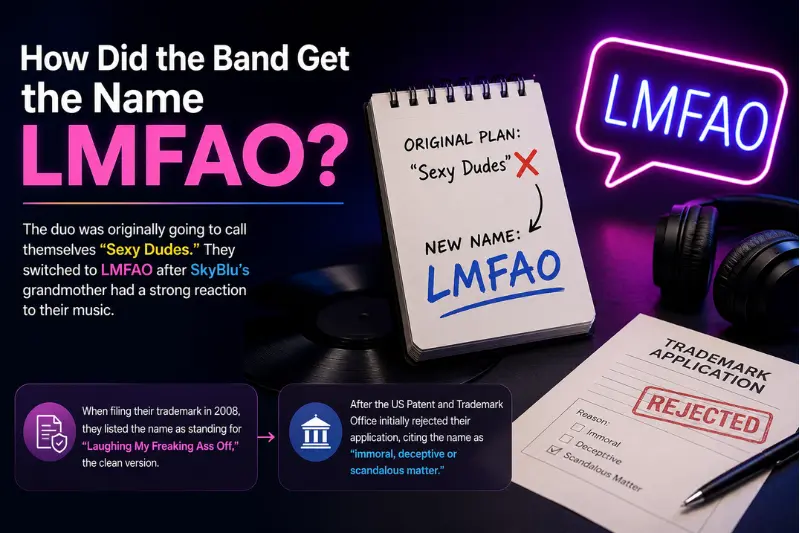
The duo were originally going to call themselves “Sexy Dudes.” They switched to LMFAO after SkyBlu’s grandmother had a strong reaction to their music. When filing their trademark in 2008, they listed the name as standing for “Laughing My Freaking Ass Off,” the clean version, after the US Patent and Trademark Office initially rejected their application, citing the name as potentially “immoral, deceptive or scandalous matter.” It is a reminder that even the most innocent-sounding words carry weight depending on context, something that applies just as much to a nickname like Pookie as it does to a band name fighting for trademark approval.
Their biggest hits:
- “Party Rock Anthem” (2011): spent 6 consecutive weeks at No. 1 on the Billboard Hot 100; topped charts in 12+ countries including the UK, Australia, Canada, and Germany; became the third best-selling digital single of 2011 with 9.7 million copies sold worldwide.
- “Sexy and I Know It” (2011): their second No. 1 on the Billboard Hot 100.
- “I’m in Miami Bitch” (2009): became the theme of E!’s Kourtney and Khloé Take Miami.
In February 2012, they performed alongside Madonna at the Super Bowl XLVI halftime show. In September 2012, they announced an indefinite hiatus to pursue solo projects. They have not officially reunited since.
Genuine vs Sarcastic LMFAO: Why the Same Word Means Two Opposite Things
This is the most practically useful thing to understand about LMFAO, and almost no article covers it properly.
LMFAO does not always mean the person is laughing. The same three letters can carry entirely different meanings depending on context, tone, and relationship.
Mode 1: Genuine LMFAO (actually laughing)
“Bro I just knocked over an entire display at the supermarket trying to reach one thing LMFAO”
The sender is laughing at their own misfortune. The LMFAO signals self-deprecating humor and shared amusement. It is warm and inviting; they want you to find it funny too.
Mode 2: Sarcastic LMFAO (not laughing at all)
“They promoted him after that presentation? LMFAO.”
No laughter is happening here. This LMFAO signals disbelief, mockery, or quiet contempt. Reading it as genuine amusement would completely misread the message. The meaning is closer to “I cannot believe this” or “that is embarrassing.”
Mode 3: Passive-aggressive LMFAO (dismissal)
“LMFAO sure you did.”
This signals scepticism and low-level hostility. The person is doubting what was said, not responding with laughter.
How to tell which mode you are reading:
- What comes before it? A funny situation described = likely genuine. An absurd or frustrating situation = likely sarcastic.
- What emoji follows it? 😂 or 🤣 = genuine. No emoji or 💀 = dry, ironic, or sarcastic.
- Who sent it? Close friends use all three modes playfully. A stranger using Mode 2 or 3 can feel confrontational.
Non-native English speakers in particular benefit from knowing these three modes exist, because reading sarcastic LMFAO as genuine laughter leads to completely different conversation outcomes.
How LMFAO Is Used on TikTok, WhatsApp, Reddit, and Gaming Chats
LMFAO looks and behaves differently depending on the platform. Here is what actual usage looks like in each environment.
WhatsApp and iMessage (private texting) The most natural home for LMFAO. Used between friends to signal genuine amusement in a low-stakes, one-on-one conversation.
“Your dog knocked over the entire Christmas tree LMFAO send the video now”
TikTok comments LMFAO gets stretched on TikTok. “LMFAOOOO” with repeated letters signals escalating intensity. Frequently paired with 💀 (signifying “dead from laughter”) or 😭. Comment sections treat it as a reaction currency.
“LMFAOOOO the way he turned around 💀💀”
Instagram Appears in captions, story replies, and comment sections under memes and reels. Often used for relatable moments.
“Me: orders salad. Also me: eats half my boyfriend’s fries. LMFAO.”
Reddit Reddit communities tend to use LOL and LMAO more frequently. When LMFAO does appear, it usually signals something genuinely absurd rather than mildly funny. It carries more weight there than it does on TikTok.
Discord and Gaming Chats Fast, low-punctuation environment where LMFAO fits naturally as a quick reaction to in-game fails or teammate banter.
“he ran straight off the cliff LMFAO bro has no spatial awareness”
Dating Apps (Tinder, Bumble, Hinge) Signals playfulness and casual personality. Works well mid-conversation to build rapport. Avoid using it sarcastically in early exchanges; it can read as dismissive and kill the conversation quickly.
How Millennials, Gen Z, and Gen Alpha Each Use LMFAO Differently
Millennials (born 1981 to 1996) Millennials are the original LMFAO generation. They used it in AIM, MSN Messenger, and early Facebook. They use it sincerely, often with full punctuation and more context around it. LMFAO carries a slight nostalgic quality for this group.
“That was honestly the funniest thing I’ve seen all week, LMFAO.”
Gen Z (born 1997 to 2012) Gen Z layers LMFAO with emojis, stretched spelling, and irony. They use it sarcastically as frequently as they use it genuinely. 💀 often replaces or accompanies LMFAO to add maximum drama.
“my sleep schedule in exam season: LMFAO 💀”
Gen Alpha (born 2013 to present) The oldest Gen Alpha members are entering their teens. LMFAO is understood but competes with newer slang like “no cap,” “rizz,” and “slay.” It still circulates through meme culture, which constantly recycles older internet vocabulary.
Older adults (Gen X and Boomers) Many people over 50 who are not plugged into internet culture may find LMFAO confusing or inappropriate, because the full form contains a swear word. If you are messaging a colleague or family member in this age group, LOL or a plain “haha” avoids any awkwardness.
How to Reply When Someone Sends You LMFAO
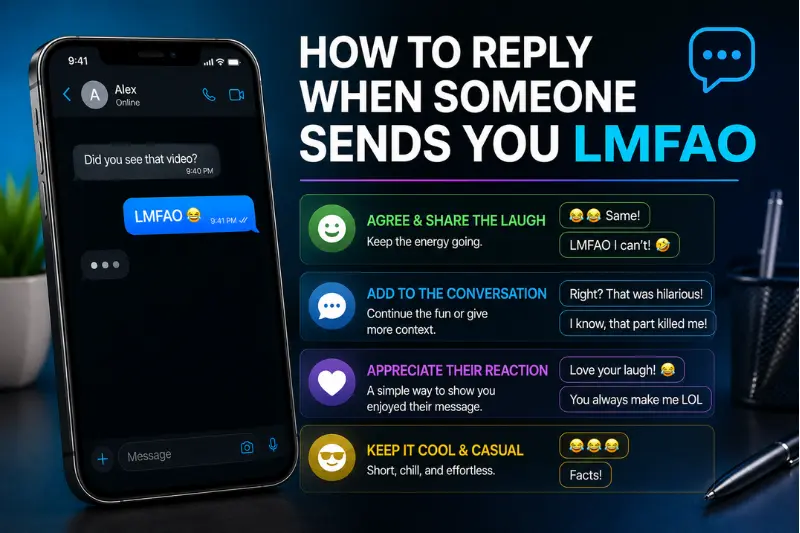
To a close friend: Match the energy and keep the momentum going.
- “LMFAO I told you that would happen”
- “😭😭 why did I watch this at 2am”
- “I cannot stop replaying this honestly”
To someone you just met or a newer friend: Keep it warm without overshooting.
- “Haha right? Same honestly”
- “😂 okay that actually got me”
- “Not wrong at all”
To someone you like / a romantic interest: Show you share their humor without going overboard.
- “Okay that was actually hilarious 😂”
- “LMFAO stop you’re so funny”
- “Didn’t see that coming 💀”
When you cannot tell if it is sarcastic: Acknowledge neutrally and let them clarify.
- “Lol right? Honestly”
- “Tell me how you really feel 😂”
- “Was not expecting that reaction”
6 Situations Where You Should Never Use LMFAO
1. Work emails and professional Slack messages Even in casual company cultures, LMFAO in a message to a manager or client signals poor judgment. Use “haha,” “that’s funny,” or nothing at all.
2. Academic writing and student group chats Even when a university WhatsApp group feels informal, mixing expletive-based acronyms with academic communication creates a poor impression, especially with professors or seniors in the thread.
3. Family group chats with mixed age ranges If grandparents, aunts, uncles, or parents who are not online-native are in the chat, LMFAO can land confusingly or feel disrespectful. Read who is in the group first.
4. First messages to strangers Opening a conversation with LMFAO, particularly as a response to something someone shared, can read as mocking or dismissive even when that was not the intent. Establish context first.
5. Sensitive or emotional conversations If someone is sharing something vulnerable and tries to lighten it with a joke, responding with LMFAO can undermine the emotional weight of what they said. Match the emotional register of the conversation, not just the surface-level humor.
6. Official complaints, reviews, or public-facing writing If you are writing a review, a formal complaint, or any content that will represent you publicly beyond a casual post, LMFAO weakens your credibility even if the situation genuinely deserves it.
A Plain-English Guide for Non-Native Speakers
Is LMFAO rude? Not between friends. The full form contains a swear word, but in casual digital communication between peers, it is processed as an expression of laughter rather than aggression. Whether to use it depends on your relationship with the person and the formality of the conversation, not the word itself.
Can I use LMFAO back if someone sends it to me? Yes. If the other person used it first in a friendly exchange, using LMFAO in reply is completely natural. If you are unsure about the tone, 😂 or “haha” works equally well without any risk.
Will native English speakers find it strange if I use it? No. Millions of non-native English speakers use internet slang fluently. The only time it could seem unusual is if the rest of your messages are very formal in tone and LMFAO appears suddenly. Keep the register of the conversation consistent.
Should I ever use it in English coursework or academic writing? Never. LMFAO is informal internet slang. It has no place in essays, coursework, presentations, or any academic setting.
LMFAO Alternatives Ranked by Context
| Situation | Best Alternative |
|---|---|
| Talking to someone you just met | LOL or 😂 |
| Work-adjacent casual chat | “Haha that’s funny” |
| Family members (mixed ages) | 😂 or just “haha” |
| Mild amusement only | LOL |
| Strong laughter with close friends | LMAO |
| Maximum dramatic effect | ROFL or 💀 |
| Irony or dry humor on social media | “I’m dead” or 😭 |
| Formal acknowledgment of something funny | “That’s genuinely hilarious” |
Frequently Asked Questions
What does LMFAO mean in text?
LMFAO stands for “Laughing My F**king Ass Off.” It is used in texts, social media, and online chats to express intense, exaggerated laughter, significantly stronger than LOL or LMAO. The first documented use appears in the Oxford English Dictionary from 1993.
What is the difference between LMFAO and LMAO?
LMAO stands for “Laughing My Ass Off.” LMFAO adds “F**king” (or “Freaking”) for extra emphasis and intensity. Think of LMFAO as the high-energy version of LMAO, reserved for moments that genuinely exceed regular amusement. Using LMFAO where LMAO would do can come across as overselling the moment.
What does the F in LMFAO stand for?
In the original form, F stands for “F**king.” In contexts where profanity is inappropriate, such as brand communications, family-friendly platforms, or official trademark filings, it is substituted with “Freaking,” making the full form “Laughing My Freaking Ass Off.”
Who is LMFAO the band and what happened to them?
LMFAO was an American electronic dance music duo consisting of uncle and nephew Stefan “Redfoo” Gordy and Skyler “SkyBlu” Gordy, both relatives of Motown Records founder Berry Gordy Jr. They formed in 2006 in Los Angeles and are best known for “Party Rock Anthem” (2011), which spent 6 weeks at No. 1 on the Billboard Hot 100 and sold 9.7 million copies worldwide. They performed at the Super Bowl XLVI halftime show alongside Madonna in February 2012, then announced an indefinite hiatus in September 2012. They have not officially reunited since.
Why did the band LMFAO choose that name?
The duo originally planned to call themselves “Sexy Dudes.” They switched to LMFAO after SkyBlu’s grandmother had a memorable reaction to their music. When they filed a trademark in 2008, the US Patent and Trademark Office initially rejected the name, describing it as “immoral, deceptive or scandalous matter.” The duo registered it using the cleaner version: “Laughing My Freaking Ass Off.”
Is LMFAO offensive?
In casual conversation between friends and peers, LMFAO is generally not considered offensive. The context makes it clear it expresses laughter, not hostility. However, because the full form contains a swear word, it is inappropriate in professional, academic, or formal settings, and can make a poor impression on people who are not familiar with internet slang.
Can LMFAO be used sarcastically?
Yes, and it frequently is. “LMFAO they actually believed that?” or “LMFAO imagine thinking that” both signal disbelief or dry humor rather than actual laughter. Reading sarcastic LMFAO as genuine amusement is one of the most common misreadings in digital communication, especially for non-native speakers.
Is LMFAO still used in 2026?
Yes. Despite competition from newer expressions and emoji-based reactions, LMFAO remains one of the most widely recognized laughter acronyms across text messaging, TikTok, Discord, and meme culture. Its 30-year presence in internet slang has made it durable in a way that newer, trendier expressions often are not.
What should I reply when someone texts me LMFAO?
Match the energy of the message. If it reads as genuine laughter, respond with humor, agreement, or your own reaction (LMFAO back, 😂, 💀, or a follow-up joke). If it reads as sarcastic, respond neutrally and let them clarify the tone. There is no single correct reply; context and relationship determine what fits.
What is the difference between LMFAO and ROFL?
ROFL stands for “Rolling On the Floor Laughing” and emphasizes a physical, uncontrollable reaction. LMFAO focuses on the emotional intensity of the laughter. Both sit at the high end of the laughter scale, but ROFL is more theatrical and less common in everyday texting. LMFAO is used far more frequently across platforms.
When was LMFAO first used?
According to the Oxford English Dictionary, the earliest documented use of LMFAO dates to 1993, in an early internet forum, more than a decade before social media existed. It spread gradually through AOL Instant Messenger and MSN Messenger before becoming a standard part of internet communication.
Does LMFAO mean different things when sent by different people?
The meaning of LMFAO does not change based on who sends it, but the intent behind it does. Context, tone, and your relationship with the sender determine whether LMFAO is genuine laughter, sarcasm, playful banter, or dry dismissal. The word is the same; the reading of it is personal.
Final Word: What LMFAO Really Tells You
LMFAO is a 30-year-old piece of internet language that has outlasted dozens of social platforms, two generations of slang, and an entire music duo that borrowed its name to sell records worldwide.
At its core, LMFAO means “Laughing My F**king Ass Off,” but the real value of understanding it goes beyond the full form. Knowing where it sits on the laughter scale, how tone shifts its meaning from genuine delight to quiet sarcasm, how each generation reaches for it differently, and when it will embarrass you rather than connect you: that is what actually makes you fluent in how people communicate online in 2026.
The acronym is not going anywhere. Neither is the need to read it correctly.
YOU MAY ALSO LIKE:
What About You Meaning in Hindi
Pookie Meaning in Hindi: Real Meaning, Use & Examples
Why Does a Dilemma Secretly Sabotage Your Decision-Making?
FCI HRMS: Login, Payslip, Leave, ERS Portal, App & Employee Services