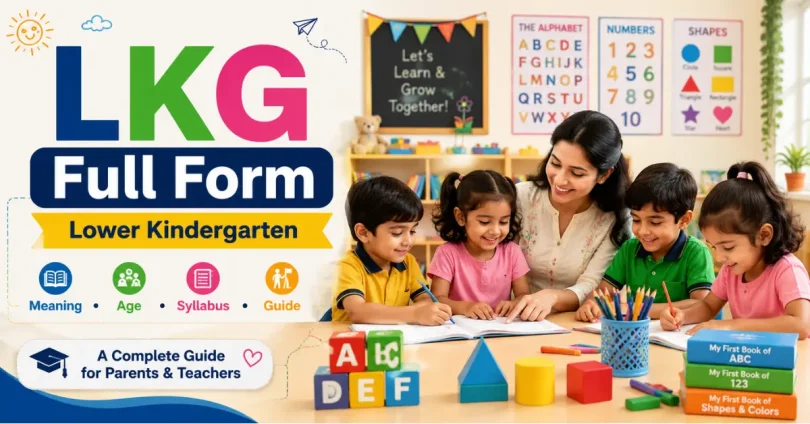

The LKG full form is Lower Kindergarten. It is one of the first stages of pre-primary education, in which young children begin learning basic letters, numbers, colors, shapes, rhymes, manners, and social skills.
In simple words, LKG is the class that usually comes after Nursery and before UKG. It helps children move from a playful home environment to a more structured school routine without putting too much academic pressure on them.
For many parents, the term LKG full form looks simple, but the class itself plays an important role in a child’s early learning journey. It builds confidence, communication, listening habits, motor skills, and school readiness.
Quick Answer: What Is the Full Form of LKG?
| Short Form | Full Form | Meaning |
|---|---|---|
| LKG | Lower Kindergarten | A pre-primary class before UKG |
| UKG | Upper Kindergarten | The next pre-primary class after LKG |
The LKG full form in English is Lower Kindergarten.
The LKG full form in Hindi can be written as लोअर किंडरगार्टन.
What Does LKG Mean in School?
In school education, LKG means Lower Kindergarten, a beginner-level class for young children. It is not the same as Class 1. Instead, it is part of early childhood education, where children learn through play, stories, songs, activities, and simple classroom routines.
The main purpose of LKG is not to make children memorize heavy lessons. Its real goal is to help them become comfortable with learning.
In LKG, children usually learn:
- Alphabet recognition
- Basic phonics sounds
- Numbers and counting
- Colors and shapes
- Rhymes and songs
- Simple drawing and coloring
- Story listening
- Sharing and group play
- Basic discipline and classroom habits
A good LKG class should feel warm, safe, and active. Children should enjoy learning instead of feeling afraid of school.
Ideal Age for LKG Admission
The ideal age for LKG admission usually depends on the school, board, city, and state rules. However, many schools accept children around 4 to 5 years of age for LKG.
Some schools may allow admission at 3.5 years, while others may prefer the child to be closer to 4 years. Parents should always check the school’s official age cutoff before applying.
| Class Level | Common Age Range | Main Focus |
|---|---|---|
| Playgroup / Pre-Nursery | 2 to 3 years | Free play, social comfort, sensory activities |
| Nursery | 3 to 4 years | Basic recognition, rhymes, habits, group play |
| LKG | 4 to 5 years | Alphabets, numbers, motor skills, early concepts |
| UKG | 5 to 6 years | Reading readiness, writing practice, basic math |
| Class 1 | 6+ years | Formal primary education |
This age range is only a general guide. The best decision depends on the child’s readiness, not only the birth date.
Is LKG Compulsory?
LKG may not be legally compulsory everywhere, but many schools prefer children to complete Nursery, LKG, and UKG before entering Class 1. These years help children develop the basic skills needed for formal learning.
Skipping LKG can be difficult for some children because they may miss early exposure to:
- Classroom routines
- Pencil control
- Listening habits
- Social interaction
- Basic letters and numbers
- Confidence in speaking
However, every child is different. Some children adjust quickly even if they start directly from LKG or UKG. Parents should focus on the child’s comfort, confidence, and readiness.
Why LKG Is Important for Children

LKG is important because it builds the foundation for future learning. At this age, children are curious, active, and quick to absorb new things. A good LKG environment positively uses this natural curiosity.
Here is why LKG matters:
It Builds School Readiness
Children learn how to sit in a group, listen to teachers, follow simple instructions, and participate in classroom activities. These habits make the move to UKG and Class 1 smoother.
It Improves Communication Skills
Through rhymes, storytelling, picture reading, and group conversation, children slowly become more confident in speaking and expressing themselves.
It Develops Basic Literacy
Children start recognizing letters, sounds, and simple words. They do not need heavy reading pressure, but early exposure helps them understand language better.
It Supports Early Numeracy
Counting, matching, sorting, comparing sizes, and recognizing shapes help children develop basic mathematical thinking.
It Builds Social Skills
LKG teaches children how to share, wait for their turn, greet others, work in groups, and respect classroom rules.
It Strengthens Motor Skills
Coloring, tracing, clay work, puzzles, blocks, and craft activities improve hand movement, finger control, and coordination.
LKG Syllabus: What Do Children Learn?
The LKG syllabus is usually simple and activity-based. It may vary from school to school, but the core learning areas are mostly similar.
English in LKG
In English, children usually learn:
- Capital and small letters
- Letter sounds
- Picture-word association
- Basic vocabulary
- Simple rhymes
- Story listening
- Tracing lines and letters
- Beginning sounds like A for Apple and B for Ball
The focus should be on recognition and sound awareness, not forced reading.
Maths in LKG
In Maths, children usually learn:
- Numbers 1 to 50
- Counting objects
- Big and small
- Tall and short
- More and less
- Shapes
- Colors
- Simple patterns
- Matching and sorting
Maths in LKG should be taught with toys, objects, pictures, and games.
Environmental Awareness
This subject helps children understand the world around them. Topics may include:
- My family
- My body
- Fruits and vegetables
- Animals and birds
- Seasons
- Good habits
- Community helpers
- Transport
- Festivals
- Cleanliness
These topics make learning connected to daily life.
Art, Craft and Activities
Art and activity time is very important in LKG. Children may do:
- Coloring
- Finger painting
- Paper tearing and pasting
- Clay modeling
- Drawing
- Music and dance
- Storytelling
- Outdoor games
- Puzzle solving
These activities support creativity, confidence, and motor development.
LKG vs Nursery vs UKG
Many parents get confused between Nursery, LKG, and UKG. These three stages are connected, but they are not the same.
| Point | Nursery | LKG | UKG |
|---|---|---|---|
| Full Form | Nursery has no fixed full form | Lower Kindergarten | Upper Kindergarten |
| Common Age | 3 to 4 years | 4 to 5 years | 5 to 6 years |
| Learning Style | Mostly play-based | Play + basic learning | More structured learning |
| Writing Practice | Very limited | Tracing and pre-writing | Letters, words, and simple sentences |
| Maths Level | Basic counting exposure | Numbers, shapes, patterns | Numbers, simple addition/subtraction |
| Main Goal | School comfort | Foundation building | Class 1 readiness |
The main difference is progression. Nursery helps children settle into school. LKG introduces early academic concepts. UKG prepares children for primary classes.
LKG and UKG Full Form

Parents often search for LKG and UKG full form together because both are part of pre-primary education.
- LKG full form: Lower Kindergarten
- UKG full form: Upper Kindergarten
LKG comes first, and UKG comes after it. In LKG, children learn basic concepts. In UKG, they revise those concepts and move toward more confident reading, writing, and number work.
What Skills Should a Child Have Before Joining LKG?
A child does not need to know everything before joining LKG. Schools do not expect perfect writing or reading at this level. However, a few basic readiness signs can help.
Your child may be ready for LKG if they can:
- Stay away from parents for a short time
- Follow simple instructions
- Speak basic words or short sentences
- Hold crayons or pencils roughly
- Recognize some objects, colors, or pictures
- Sit for a short activity
- Play with other children
- Use the toilet with little help or communicate needs
Do not worry if your child is shy. Many children become confident after a few weeks of school.
Documents Required for LKG Admission
Most schools ask for basic documents during LKG admission. The exact list may vary, but common documents include:
- Child’s birth certificate
- Passport-size photographs
- Parent or guardian ID proof
- Address proof
- Child’s Aadhaar card, if available
- Previous preschool record, if applicable
- Medical or vaccination record, if required by the school
Parents should keep photocopies and digital copies ready before the admission season starts.
How to Choose the Right LKG School
Choosing the right LKG school is more important than choosing the most famous school. At this age, children need safety, patience, warmth, and playful learning.
Before finalizing a school, check these points:
Teacher Behavior
The teacher should be calm, friendly, and patient. A strict or fearful environment is not suitable for young children.
Classroom Safety
The classroom should be clean, colorful, safe, and child-friendly. Furniture should match the child’s height and age.
Learning Method
A good LKG class should not depend only on worksheets. It should include stories, games, music, art, outdoor play, and hands-on activities.
Student-Teacher Ratio
Smaller groups help teachers give better attention to each child.
Distance from Home
For LKG children, a nearby school is often better because long travel can make them tired.
Communication with Parents
The school should update parents about the child’s progress, behavior, strengths, and areas needing support.
Common Mistakes Parents Make During LKG Admission
Many parents focus only on school name, fees, or English-speaking environment. These are not the only things that matter.
Avoid these mistakes:
- Choosing a school only because it is popular
- Forcing early writing before the child is ready
- Comparing your child with other children
- Ignoring travel distance
- Selecting a school with too much homework
- Not checking teacher behavior
- Expecting Class 1-level learning in LKG
- Pressuring the child to read and write perfectly
LKG should create love for learning, not fear of learning.
What Should Parents Teach at Home Before LKG?
Parents can support children at home in a simple and natural way. You do not need expensive books or heavy tuition.
You can help your child by:
- Reading short picture books
- Talking about daily objects
- Singing rhymes
- Practicing colors and shapes through toys
- Letting the child draw freely
- Teaching basic greetings
- Encouraging sharing and patience
- Building a regular sleep routine
- Allowing independent eating and basic self-care
Small daily habits help more than long study hours.
Difference Between LKG Full Form and Kindergarten
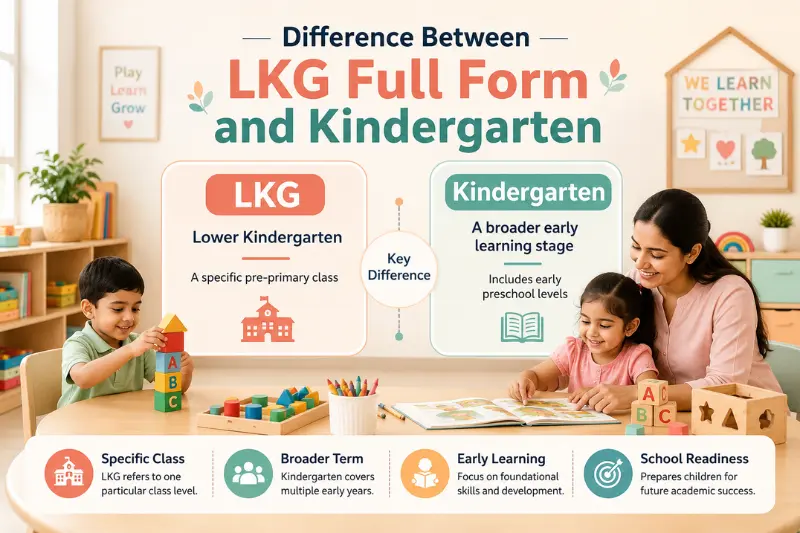
The LKG full form is Lower Kindergarten, while Kindergarten is the broader term for early childhood classes before primary school.
In many schools, Kindergarten is divided into two levels:
- Lower Kindergarten
- Upper Kindergarten
That is why LKG and UKG are commonly used in India and some other countries. In simple terms, LKG is the lower level of Kindergarten, and UKG is the upper level.
Is LKG the Same in CBSE, ICSE and State Board Schools?
The basic purpose of LKG is similar across CBSE, ICSE, and State Board schools. However, the teaching style and syllabus depth may differ.
CBSE schools may follow a more balanced and activity-based structure. ICSE schools may give stronger focus to English language exposure. State Board schools may include more local language and regional learning elements.
Parents should not choose a board only by reputation. At the LKG level, the teaching method, teacher quality, safety, and child comfort matter more than the board name.
Final Thoughts
The LKG full form is Lower Kindergarten, but LKG is more than just a short form. It is an important early learning stage where children begin their school journey with basic concepts, social habits, communication skills, and confidence.
A good LKG experience should be playful, safe, and age-appropriate. Children should learn letters and numbers, but they should also sing, draw, listen to stories, ask questions, play with friends, and enjoy school life.
For parents, the best approach is simple: choose a school that understands young children. Do not rush your child into heavy academics. Let LKG become a happy foundation for lifelong learning.
FAQs About LKG Full Form
What is the LKG full form?
The LKG full form is Lower Kindergarten. It is a pre-primary class before UKG.
What is the LKG full form in English?
The LKG full form in English is Lower Kindergarten.
What is the LKG full form in Hindi?
The LKG full form in Hindi is लोअर किंडरगार्टन.
What is the right age for LKG?
The common age for LKG is around 4 to 5 years, but the exact age depends on the school and local admission rules.
What comes after LKG?
UKG comes after LKG. UKG stands for Upper Kindergarten.
Is LKG before Nursery?
No. In most schools, Nursery comes before LKG, and UKG comes after LKG.
Is LKG compulsory for Class 1?
LKG may not be compulsory everywhere, but it helps children prepare for UKG and Class 1. Many schools prefer children to complete pre-primary education first.
What is taught in LKG?
Children learn alphabets, numbers, colors, shapes, rhymes, stories, drawing, basic manners, motor skills, and social habits.
Is LKG good for children?
Yes, LKG is helpful when the school uses age-appropriate and activity-based teaching. It helps children build confidence and early learning skills.
What is the difference between LKG and UKG?
LKG is the lower level of Kindergarten, while UKG is the upper level. LKG focuses on basic learning, and UKG prepares children for Class 1.