Quick Answer Box: The FYIP full form is “For Your Information Please” a polite, professional abbreviation used in emails, workplace chats, and formal business messages to share information without expecting a reply. It is the respectful upgrade of FYI, most commonly used when writing to a manager, client, or senior colleague.
However, FYIP has 10+ distinct meanings across different industries from corporate planning to agriculture. Using the wrong one in the wrong context can cause genuine misunderstanding.
This guide covers every FYIP meaning with verified context, real copy-paste templates, a side-by-side comparison with FYI and similar abbreviations, and platform-specific usage rules. Everything you need to use FYIP correctly in 2026.
Table of Contents
What Is the FYIP Full For?
FYIP stands for “For Your Information Please.”
It is a formal, respectful variation of FYI (For Your Information). The addition of “Please” is not decorative. It fundamentally shifts the tone of the message from neutral to courteous, making FYIP the more appropriate choice whenever hierarchy, professionalism, or cross-cultural politeness matters. If you frequently come across professional abbreviations, understanding the FRP full form can also help you interpret technical and workplace communication more accurately.
Think of it this way:
- FYI = “Here is the information.” (direct, neutral)
- FYIP = “Here is the information, and I am sharing it respectfully.” (formal, polite)
Where you will encounter FYIP:
- Corporate emails between employees, managers, and external clients
- Workplace messaging platforms (Slack, Microsoft Teams, Google Chat)
- Academic emails between students and faculty
- Government and administrative correspondence
- Professional WhatsApp groups in hierarchical work environments
What does a FYIP message actually do? When a sender writes FYIP at the start of a message, they are communicating three things simultaneously:
- The information that follows is important enough to share
- No immediate response or action is expected from the reader
- The sender respects the reader’s time and position
This triple function makes FYIP more information-dense than it appears.
All FYIP Full Forms Across Different Fields
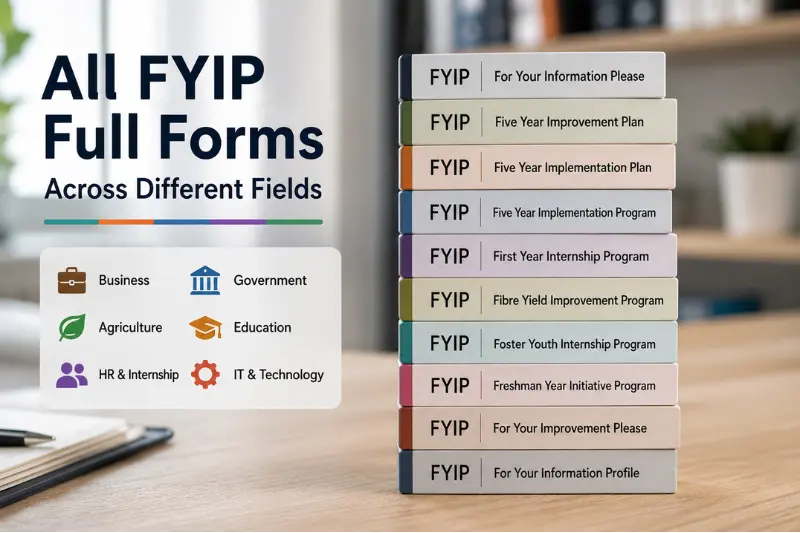
Most articles give you only one FYIP meaning. That is a problem because the same four letters carry very different meanings depending on where you encounter them.
Here is the complete reference table:
| FYIP Full Form | Field / Context | What It Actually Means |
|---|---|---|
| For Your Information Please | Email & Digital Communication | Polite sharing of information without expecting action |
| Five Year Improvement Plan | Government & Municipal Planning | A structured 5-year roadmap for institutional improvement |
| Five Year Implementation Plan | Corporate Strategy & NGOs | Execution timeline spanning five years for a project |
| Five Year Implementation Program | Policy & Public Works | Phased government or agency program over five years |
| First Year Internship Program | HR & Academic Institutions | Entry-level internship designed for first-year students |
| Fibre Yield Improvement Program | Agriculture | Program to increase crop fibre output (cotton, jute, flax) |
| Foster Youth Internship Program | Social Services & Government | Internship initiative specifically for youth in foster care |
| Freshman Year Initiative Program | Higher Education | A structured support program for incoming first-year students |
| For Your Improvement Please | Feedback & Performance Coaching | Constructive feedback framing in appraisals or coaching |
| For Your Information Profile | IT & Computing | Reference to a user’s information profile within a system |
The most searched meaning globally remains “For Your Information Please,” particularly in professional email, WhatsApp groups, and workplace messaging. The Five Year plan meanings dominate in policy documents and formal reports.
Before assuming what FYIP means in a document, scan the surrounding text for context clues. A document about infrastructure or healthcare strategy will almost certainly use FYIP to mean a Five Year plan rather than a communication note. Likewise, understanding the meaning of common expressions like Happy Eve can help you avoid misinterpreting messages in everyday conversations.
The Origin of FYIP: Where Did It Come From?
Understanding where FYIP came from explains why it is used differently in different parts of the world and why it matters more in some professional cultures than others.
The roots of FYI
FYI has been documented in English business communication since the 1940s, originally appearing in internal office memos in the United States. It was a shorthand way for office workers to pass along information without implying the reader needed to take any action.
As email became the dominant form of business communication through the 1990s, FYI moved seamlessly into digital use. It became a standard prefix in workplace emails, instant messaging, and eventually SMS.
How FYIP evolved from FYI
FYIP did not emerge from a corporate boardroom. It evolved organically in professional environments where polite communication is culturally embedded most notably across South Asia (India, Pakistan, Bangladesh, Sri Lanka) and Southeast Asia (Philippines, Malaysia, Indonesia).
In these professional cultures, sending an email to a senior colleague or manager with the blunt abbreviation FYI can read as insufficiently respectful. Adding “Please” to create FYIP aligns with the communication norms of these regions, where politeness markers are not optional extras but expected signals of professional respect.
This practice spread through multinational companies operating in these regions and gradually became recognized in international business communication. By the early 2010s, FYIP was appearing regularly in email threads between globally distributed teams, and by the mid-2010s, it began accumulating search volume globally. Just as professional abbreviations evolve over time, everyday expressions such as sunshine can also carry different meanings depending on the context, especially in relationships and conversations.
Today, FYIP is recognised as a legitimate professional abbreviation in both formal and semi-formal business contexts particularly across Asia, the Middle East, East Africa, and in multinational organisations worldwide.
FYIP vs. FYI vs. FYA vs. NB: Full Comparison Table
Choosing the wrong abbreviation changes the meaning and tone of your message. Here is the complete comparison not just FYI vs. FYIP, but every abbreviation you might consider:
| Abbreviation | Full Form | Tone | Requires Action? | Best Used In |
|---|---|---|---|---|
| FYIP | For Your Information Please | Formal, polite | No | Emails to seniors, clients, formal settings |
| FYI | For Your Information | Neutral, direct | No | Peer-level updates, casual workplace messages |
| FYA | For Your Action | Directive | Yes | Task delegation, assigning work to someone |
| NB | Nota Bene (Note Well) | Formal, academic | Depends | Academic writing, legal documents, footnotes |
| PSA | Public Service Announcement | Informational, broad | No | Group announcements, social media posts |
| JFYI | Just For Your Information | Casual, friendly | No | Informal chats, friendly workplace messages |
| ATTN | Attention | Urgent, directive | Yes | Flagging priority messages, formal memos |
Decision guide which one should you use?
- Writing to your manager or a client FYIP
- Writing to a colleague at the same level FYI
- Someone needs to do something FYA
- Adding a footnote in a formal document NB
- Texting a friend a heads-up JFYI
- Flagging an urgent message for a specific person ATTN
How to Use FYIP Correctly With Real Examples
FYIP belongs at the beginning of a sentence or message it is a signal, not a subject. It tells the reader what kind of message they are about to receive before they read it.
Correct usage:
FYIP, the system will be offline for maintenance from 11 PM to 2 AM tonight.
FYIP: The board has approved the revised project budget. Full details are in the attached document.
FYIP I have forwarded your proposal to the procurement team on your behalf.
FYIP, there will be no parking available at the head office on Thursday due to construction.
Incorrect usage and why it fails:
“Please find FYIP attached.” FYIP is not a noun. It cannot be “attached” or “found.” This is a grammatical error.
“I am writing to FYIP you about the schedule change.” FYIP is not a verb. You cannot use it as one.
“FYIP, could you please review and approve this document by Friday?” This asks for action. Use FYA instead, since you are delegating a task.
“Hey! FYIP, the party is at 8 PM.” FYIP in casual social contexts feels stiff and out of place. “Just so you know” or a simple FYI works better here.
The single rule that covers everything: If the message requires the reader to do something use FYA. If the message simply informs use FYIP (formal) or FYI (casual).
Copy-Paste FYIP Email and Message Templates
These are not filler templates. Each one is written for a specific real-world scenario you can adapt immediately.
Template 1: Informing a Manager About a Completed Task
Subject: FYIP Assignment Submitted Successfully
Dear [Manager’s Name],
FYIP, I have submitted the monthly compliance report to the finance department as of [Date] at [Time]. The submission reference number is [XXXX].
No action is required from your end. I wanted to keep you informed as per standard reporting procedure.
Best regards, [Your Name]
Template 2: Team-Wide Policy or Process Update
Subject: FYIP Change to Meeting Room Booking Process
Hi Team,
FYIP, the meeting room booking system has been updated. All bookings must now be made through the new platform at [Link]. Your existing logins remain valid.
This change takes effect from [Date]. No disruption to existing bookings is expected.
Best, [Your Name]
Template 3: Client or External Stakeholder Update
Subject: FYIP Project Milestone Completed
Dear [Client Name],
FYIP, Phase 1 of the [Project Name] has been completed on schedule as of [Date]. All deliverables from this phase have been shared with your team via [platform/email].
We will proceed to Phase 2 beginning [Date] as planned. No input is required from your end at this stage.
Warm regards, [Your Name]
Template 4: Academic Email to a Professor
Dear Professor [Name],
FYIP, I have submitted my [assignment/thesis draft/project report] through the student portal as of [Date] at [Time]. My submission ID is [XXXX].
Thank you for your time. No response is needed.
Regards, [Your Name] [Student ID]
Template 5: WhatsApp / Slack Short Message
FYIP The deadline for submitting timesheets has been moved to [Date] this week due to the public holiday. No reply needed, just keep this updated.
Template 6: Feedback and Coaching Context (For Your Improvement Please)
FYIP The presentation would be stronger with fewer bullet points per slide and larger font sizes throughout. This will improve readability for a live audience and reduce the cognitive load on viewers.
Platform-by-Platform FYIP Usage Guide
The same abbreviation reads differently depending on where it appears. Here is exactly how to deploy FYIP on each platform. The same principle applies to modern texting abbreviations like IONK, whose meaning can also change depending on the conversation and platform where it is used.
Gmail / Outlook
Use FYIP freely it is perfectly calibrated for formal email communication. Place it at the very start of your email body, or include it in the subject line for immediate clarity. Follow it with a full sentence of context never write FYIP alone without explaining what the information is. Particularly effective in subject lines: “FYIP Policy Update Effective January 2026”
Microsoft Teams / Slack
Appropriate in professional channels for team-wide announcements. Works well in pinned messages or channel descriptions. In informal team chats with close colleagues, FYI reads more naturally FYIP can feel overly stiff in a conversational thread. Use FYIP when posting in channels monitored by senior stakeholders.
WhatsApp (Professional Groups)
Effective in workplace WhatsApp groups, especially when your message goes to a manager, client, or mixed-level group. In personal or friend groups, FYIP is unnecessary formality. Use plain language instead. Keep the message brief one or two sentences is ideal for WhatsApp context.
LinkedIn (Direct Messages)
Appropriate in professional DMs, particularly when sharing industry updates or following up with a contact. Use in direct messages, not in public posts FYIP in a public LinkedIn post reads as unnecessarily formal and may reduce engagement.
SMS / Text Messages
Only use in a professional text context messaging a client about a delivery update, for example. In personal texts, FYIP sounds corporate and detached. Avoid it.
Formal Letters, Memos, and Official Documents
Ideal for internal office memos, interoffice correspondence, and formal letters. Use FYIP in the reference line, subject line, or opening paragraph. In a formal letter format: “FYIP: This letter confirms the completion of [X] as per our agreement dated [Y].”
FYIP in Different Cultures and Regions
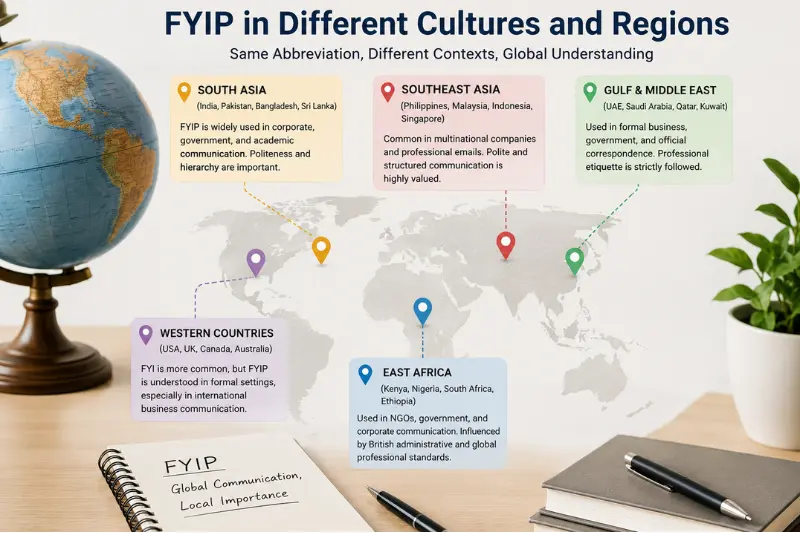
FYIP is not used equally everywhere. Its frequency and appropriateness vary based on regional communication culture and understanding this prevents miscommunication in international workplaces.
South Asia India, Pakistan, Bangladesh, Sri Lanka FYIP is common in corporate, government, and academic email communication across South Asia. Professional communication in this region carries strong norms of hierarchical respect using “Please” is not optional but expected when communicating upward. FYIP fits naturally into this culture and is widely understood in both the private sector and government offices.
Southeast Asia Philippines, Malaysia, Indonesia, Singapore Formal communication norms in multinational companies across Southeast Asia closely align with global standards but with an additional layer of politeness. FYIP is used regularly in corporate emails, especially in companies with overseas headquarters. The Philippines in particular has a strong tradition of formal email etiquette, and FYIP appears frequently in inter-departmental communication.
Gulf and Middle East UAE, Saudi Arabia, Qatar, Kuwait Formal business email in Gulf countries follows structured etiquette. FYIP is understood and used in inter-departmental and upward communication, particularly in government entities and multinational companies. Formal letters and official correspondence in the region align well with FYIP’s tone.
Western Countries US, UK, Canada, Australia FYI dominates in Western corporate culture, where brevity and directness are valued communication norms. FYIP is understood but used less frequently. In international business communication particularly when a Western professional is writing to a South Asian or Southeast Asian colleague FYIP can signal cultural awareness and respect.
East Africa Kenya, Nigeria, South Africa, Ethiopia English-speaking professional environments in East and West Africa follow formal communication structures influenced by both British administrative tradition and multinational corporate norms. FYIP appears in NGO communication, government correspondence, and multinational company emails in these regions.
FYIP in Business and Government: The Five-Year Meaning
When FYIP appears in a policy document, government report, NGO project file, or formal business strategy paper, it almost never means “For Your Information Please.”
In these contexts, FYIP typically refers to one of three things:
Five Year Improvement Plan Used in municipal government, healthcare, and education sector planning. A Five Year Improvement Plan sets measurable targets and benchmarks for institutional performance over a five-year cycle.
Common in:
- Local government strategic plans
- School and education district improvement strategies
- Hospital and healthcare facility development plans
- Public infrastructure upgrade projects
Five Year Implementation Plan Used in corporate strategy and international development. This document outlines how an organisation will execute a specific project or strategy across five years including milestones, resource allocation, and accountability structures.
Common in:
- Corporate strategic planning cycles
- NGO project timelines and donor reports
- Development bank and aid agency frameworks
- National policy rollout documentation
Five Year Implementation Program Used in government ministry documentation and multi-phase public works. Similar to an Implementation Plan but typically applied to larger, phased programs involving multiple departments or agencies.
Common in:
- Ministry-level program documentation
- Multi-phase infrastructure programs
- Aid and development agency project cycles
How to tell which FYIP meaning you are reading: Read the document title, the introduction, and the first section. A communication context will never use FYIP in a document only in messages. A document that says “The FYIP outlines targets for 2026–2031” is a planning document, full stop.
Common Mistakes People Make With FYIP
These are the errors that consistently appear in professional communication and the ones most likely to undermine your credibility if left uncorrected.
Mistake 1: Using FYIP when action is actually required If your message ends with “please review,” “please approve,” or “please complete,” you are not sharing information you are delegating a task. The correct abbreviation is FYA (For Your Action). Using FYIP when you need a response creates confusion and often means your request goes unanswered.
Mistake 2: Writing FYIP without any follow-up information A message that simply says “FYIP” and nothing else is incomplete. FYIP is a signal word it must always be followed by the actual information. Example of what not to do: “FYIP about the meeting.” What meeting? What about it?
Mistake 3: Treating FYIP as a noun or verb FYIP is an adverbial modifier it qualifies the nature of the information being shared. It cannot be “attached,” “found below,” or used as an action (“I will FYIP you”). These errors reveal unfamiliarity with how abbreviations function grammatically.
Mistake 4: Using FYIP in casual personal conversations Sending “FYIP, dinner is at 7” to a friend is unnecessarily formal and can read as cold. Reserve FYIP for professional communication contexts only.
Mistake 5: Confusing communication FYIP with planning FYIP In a business strategy meeting, referring to a Five Year Implementation Plan as “the FYIP” and later receiving a message saying “FYIP, please review the agenda” creates real confusion. When both meanings are in play in the same workplace, spell out the full form at first reference.
Mistake 6: Overusing FYIP in cultures where it feels unnatural In Western professional environments where direct communication is the norm, prefacing every update with FYIP can feel passive-aggressive or bureaucratic. Read your workplace culture and calibrate accordingly.
Final Takeaway
FYIP is four letters that do more than most people realise. In day-to-day professional communication, it is the clearest signal that you are sharing information respectfully without burdening the reader with an expectation of response.
In planning and policy contexts, it anchors a five-year strategy into a single recognisable abbreviation.
Knowing which meaning applies and when to reach for FYIP versus FYI, FYA, or something else entirely is the kind of precise communication skill that separates professionals who are merely understood from those who are trusted, just as understanding terms like Pookie depends on the right context.
Use the templates, reference the comparison tables, and calibrate to your platform and culture. That is how FYIP goes from an abbreviation you vaguely recognised to a tool you use with intention.
Frequently Asked Questions
Q1: What is the FYIP full form in email?
FYIP full form in email is “For Your Information Please.” It is placed at the beginning of a professional email or message to share information with the reader in a polite and respectful way. Unlike FYI, FYIP signals extra courtesy it is most appropriate when writing to a manager, client, or senior colleague. No response is expected from a FYIP message unless the sender specifically requests one.
Q2: What is the difference between FYI and FYIP?
FYI stands for “For Your Information” and carries a neutral, direct tone. FYIP stands for “For Your Information Please” and carries a more formal, polite tone. The key practical difference is context: use FYI between colleagues at the same level in a relaxed workplace, and use FYIP when writing upward in a hierarchy, communicating with clients, or operating in a formal or cross-cultural professional environment. Both abbreviations indicate that no action is required from the reader.
Q3: Does FYIP require a reply?
No. FYIP messages are informational by design. The sender is sharing something the reader should be aware of not requesting a response, approval, or action. If the sender needs the recipient to do something, the correct abbreviation is FYA (For Your Action), not FYIP. If you receive a FYIP message, a short acknowledgement is courteous but not expected.
Q4: What does FYIP mean in a business document?
In a business or government document, FYIP typically refers to a “Five Year Improvement Plan,” “Five Year Implementation Plan,” or “Five Year Implementation Program.” It does not mean “For Your Information Please” in a document context that meaning applies only in messages and communication. Always read the surrounding text to determine which meaning is intended. A sentence such as “The FYIP sets out targets for 2026–2031” confirms you are reading a planning document.
Q5: Is FYIP formal or informal?
FYIP is formal and professional. It is not appropriate in casual personal conversations, social media posts, or informal text messages between friends. In informal contexts, “just so you know” or a plain FYI is more natural. FYIP is specifically designed for professional email, formal workplace communication, and business messaging environments.
Q6: What does FYIP mean in WhatsApp?
In WhatsApp, FYIP means “For Your Information Please.” It is used in professional group chats or direct messages to share updates or information with colleagues, managers, or clients in a polite way. FYIP is appropriate in workplace WhatsApp groups, particularly when the audience includes senior contacts. It should be avoided in personal or social WhatsApp conversations where plain language is more natural.
Q7: Can I use FYIP on LinkedIn?
Yes, FYIP is appropriate on LinkedIn in direct professional messages for example, sharing an update with a contact or following up on a professional matter. It is not well-suited for public LinkedIn posts, where plain, conversational language typically performs better and FYIP may feel unnecessarily stiff to a broad audience.
Q8: What is FYIP full form in Hindi?
FYIP का पूरा रूप है “For Your Information Please” हिन्दी में इसका अर्थ है “आपकी जानकारी के लिए, कृपया।” इसका उपयोग पेशेवर ईमेल, कार्यस्थल के संदेशों और आधिकारिक पत्राचार में विनम्रतापूर्वक जानकारी साझा करने के लिए किया जाता है जब प्रेषक को प्राप्तकर्ता से किसी प्रतिक्रिया या कार्य की आवश्यकता नहीं होती।
Q9: What is the FYIP full form in education?
In education, FYIP can carry two different meanings depending on context. In HR and university settings, it often refers to a “First Year Internship Program” a structured professional experience for students in their first year of study. In higher education administration, it can also refer to a “Freshman Year Initiative Program” a support program designed to improve retention and success among incoming students. In everyday academic communication, FYIP still means “For Your Information Please.”
Q10: What is the best alternative to FYIP?
The best alternative to FYIP depends on your purpose and audience. If you want something slightly less formal but still professional, use FYI. If you are making a group announcement, PSA works well. If the message is casual among friends, “just so you know” or JFYI is more appropriate. If you need the person to take action rather than simply receive information, use FYA. If you are adding an important note in a formal document, NB (Nota Bene) is the correct choice.
Q11: What does FYIP mean in agriculture?
In agriculture, FYIP stands for “Fibre Yield Improvement Program.” This refers to a structured initiative designed to increase the fibre output of crops such as cotton, jute, or flax. These programs are typically run by agricultural research institutes, government bodies, or development organisations to improve crop productivity, fibre quality, and farmer income through better cultivation techniques and seed varieties.
Q12: When should I use FYIP instead of FYI?
Use FYIP instead of FYI when: (1) you are writing to a manager, senior colleague, or client rather than a peer; (2) you are operating in a formal professional or cross-cultural communication environment; (3) you want your message to signal respect along with information. Use FYI when writing to colleagues at the same level, in casual or fast-paced team chats, or in Western corporate environments where directness is the norm.
YOU MAY ALSO LIKE:
Happy Eve Meaning : What It Really Means and How to Use It
Sunshine Meaning in Love: The True Emotional Meaning Explained
NMMS Meaning in Text – The Shocking Truth Behind This Viral Slang You Must Know
The Hidden Meaning of Feening Beyond Simple Slang
Good Excuses to Miss Work on Short Notice – Valid Reasons and What to Say