How do Ski Jumpers stay in the air so long? Ski jumping looks almost unreal. An athlete races down a steep ramp, launches into the air, spreads their skis into a wide V-shape, and glides for several seconds before landing far down the hill.
So, how is it possible for ski jumpers to stay in the air so long, and how do they train for that? With the right Training Guidance, the simple answer is that they utilize speed, body position, ski angle, wind, and years of practice to transform their body and skis into a flying shape. They are not truly flying like birds or airplanes. They are gliding as gravity slowly pulls them down.
The magic is not magic at all. It is physics, skill, courage, and practice.
Table of Contents
Quick Answer
Ski jumpers stay in the air for so long because they create lift with their body and skis. This is the main reason behind How Ski Jumpers Stay in the Air So Long. When they move fast through the air, their V-shaped skis and forward-leaning body push air downward. In return, the air pushes them upward.
This upward force slows their fall and helps them travel a long distance before landing.
They train for this by practicing:
- Explosive takeoff power
- Balance and body control
- Wind tunnel flight position
- Summer jumps on plastic hills
- Core strength and flexibility
- Mental focus under pressure
- Video analysis after every jump
Are Ski Jumpers Flying or Falling?
Ski jumpers are actually doing both.
They are falling because gravity always pulls them toward the ground. But they are also gliding because lift slows their fall. This is why they can stay in the air for several seconds and travel the length of a football field or more.
A normal person who jumps straight up may stay in the air for less than a second. A ski jumper can remain airborne for around 5 to 7 seconds because they move forward at high speed and use their body like a wing.
Think of the difference between a rock and a paper airplane.
A rock falls quickly because it has no useful shape for lift. A paper airplane stays in the air longer because its shape helps it glide. Ski jumpers do something similar with their skis and bodies.
The Main Physics Behind Ski Jumping
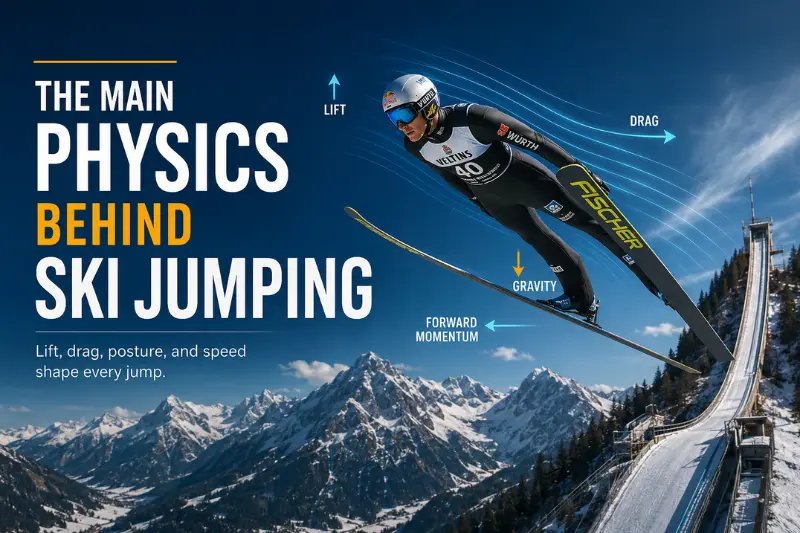
Ski jumping depends on three main forces:
- Lift
- Drag
- Gravity
These forces decide how long the jumper stays in the air and how far they travel.
Lift: The Force That Keeps Ski Jumpers Airborne
Lift is the upward force that helps ski jumpers stay in the air longer.
When a jumper moves fast through the air, the air hits their skis and body. The jumper’s position pushes some of that air downward. Because of Newton’s third law, the air pushes back upward.
That upward push is lift.
The more lift a jumper creates, the slower they fall.
Ski jumpers increase lift by:
- Spreading their skis into a V-shape
- Leaning their body forward
- Keeping their body low and flat
- Holding the right angle against the airflow
- Maintaining enough speed during flight
This is one of the biggest reasons ski jumping looks like flying.
Drag: The Force That Slows Them Down
Drag is air resistance. It pushes against the jumper and slows them down.
This matters because speed helps create lift. If a ski jumper loses too much speed, they also lose lift. When lift drops, gravity takes over faster, and the jumper lands sooner.
To reduce drag, ski jumpers:
- Keep their arms close to their bodies
- Avoid sudden movements
- Keep the chin tucked
- Wear carefully fitted suits
- Hold a smooth and stable flight position
The goal is not to remove drag completely. That is impossible. The goal is to control it.
Gravity: The Force Pulling Them Down
Gravity never stops working. It pulls every jumper back toward the slope.
Ski jumpers cannot beat gravity, but they can slow down its effect. Their lift does not make them rise forever. It only reduces how quickly they fall.
That is why ski jumping is a controlled glide, not true flight.
Why the V-Shape Helps So Much
The V-style is one of the most important techniques in modern ski jumping.
In the past, jumpers kept their skis almost parallel. Today, they spread the ski tips apart into a V-shape. This position gives them more surface area and better airflow.
The V-shape helps because it:
- Creates more lift
- Makes the jumper more stable
- Allows the body and skis to act like one large wing
- Helps the jumper control direction in the air
- Improves distance compared with the old parallel style
This is why almost every modern ski jumper uses the V-style.
Why Speed Is So Important
Speed is the hidden power behind a long ski jump.
Before takeoff, ski jumpers race down the in-run ramp at very high speed. This speed creates strong airflow around the body and skis. More airflow means more lift.
Without enough speed, even the best body position will not keep the jumper in the air for long.
Speed helps ski jumpers:
- Generate lift
- Cover more horizontal distance
- Maintain smoother flight
- Delay the landing phase
- Stay stable in the air
But too much speed can also be dangerous. That is why officials may adjust the starting gate depending on wind and hill conditions.
The Takeoff: The Most Important Split Second
The takeoff happens very quickly, but it can decide the whole jump.
Just before leaving the ramp, the jumper pushes powerfully with the legs. This movement must happen at exactly the right time. A late takeoff wastes power. An early takeoff can ruin the flight angle.
A good takeoff needs:
- Explosive leg strength
- Perfect timing
- Strong balance
- Smooth transition into flight
- Confidence and commitment
This is one area where training matters a lot. The jumper has only a tiny moment to get it right.
Perfect Body Position in the Air
Once in the air, the jumper must hold a very controlled position.
The ideal flight position usually includes:
- Body leaning forward
- Chest close to the skis
- Arms tight near the body
- Chin tucked
- Skis spread in a V-shape
- Calm and steady posture
Even small mistakes can reduce distance. A raised head, loose arm, or poor ski angle can create drag and reduce lift.
This is why elite ski jumpers spend years refining tiny body movements.
How Wind Helps or Hurts Ski Jumpers
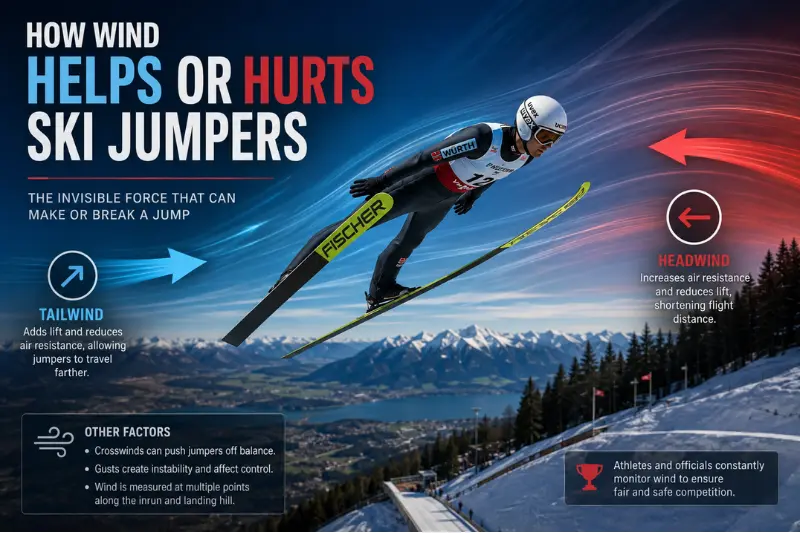
Wind can make a huge difference in ski jumping.
A headwind can help because it increases airflow under the jumper. This can create more lift and allow a longer glide.
A tailwind can hurt because it reduces useful airflow. This can shorten the jump and make flight control harder.
Wind can affect:
- Lift
- Balance
- Flight height
- Landing distance
- Safety
- Competition fairness
This is why ski jumping events use wind measurements and gate adjustments. The goal is to keep the competition fair and safe.
How Do Ski Jumpers Train for That?
Now let’s answer the second part of the keyword: how is it possible for ski jumpers to stay in the air so long and how do they train for that?
Ski jumpers train their body, mind, technique, and reaction time. They do not only practice jumping. They train like explosive athletes, gymnasts, pilots, and scientists at the same time.
Wind Tunnel Training
Wind tunnel training helps jumpers practice their flight position without using a real hill.
In a wind tunnel, athletes feel airflow around their body. Coaches can see how small changes affect lift and drag.
Wind tunnel training helps with:
- Body angle
- Arm position
- Chin position
- V-shape control
- Stability in airflow
- Reducing unnecessary movement
This type of training is useful because the athlete can repeat the flight position many times without the risk of a full jump.
Plastic Hill Training in Summer
Ski jumping is not only a winter sport. Many jumpers train during summer on plastic-covered hills.
These hills are designed to work without snow. Water is often used to make the surface slippery, similar to snow.
Summer hill training helps athletes:
- Practice takeoff timing
- Improve landing technique
- Repeat full jumps year-round
- Build confidence
- Maintain rhythm outside winter season
This is one reason professional ski jumpers can complete thousands of practice jumps over their career.
Strength Training for Explosive Takeoff
A strong takeoff needs powerful legs.
Ski jumpers train for explosive strength, not just heavy muscle size. They need to produce force quickly while staying balanced.
Common strength exercises include:
- Squats
- Jump squats
- Box jumps
- Lunges
- Single-leg jumps
- Plyometric drills
The goal is to create a powerful push at the end of the ramp without losing body control.
Core Training for Flight Stability
A ski jumper’s core is very important.
During flight, the body must stay firm and stable while air pushes against it. A weak core makes the jumper unstable and harder to control.
Core training may include:
- Planks
- Side planks
- Hanging leg raises
- Anti-rotation exercises
- Stability ball drills
A strong core helps the jumper hold the correct position for the whole flight.
Balance and Coordination Training
Ski jumping requires excellent balance. The jumper must control long skis, high speed, wind, and landing pressure.
Balance training may include:
- Balance boards
- Slackline drills
- Single-leg stability work
- Unstable surface exercises
- Reaction drills
This training improves body awareness. It helps jumpers make small corrections in the air without panicking.
Flexibility and Mobility Training
Flexibility is also important because the flight position is not natural for most people.
Jumpers need mobile hips, strong ankles, flexible hamstrings, and a stable lower back. This helps them lean forward while staying relaxed and controlled.
Good mobility helps with:
- Deeper in-run position
- Better forward lean
- Smoother landing
- Lower injury risk
- Cleaner takeoff movement
Video Analysis
Ski jumpers and coaches study every detail of a jump.
They record the in-run, takeoff, flight, and landing from different angles. Then they review the footage to find small mistakes.
Video analysis helps improve:
- Takeoff timing
- Ski angle
- Body lean
- Arm position
- Flight stability
- Landing form
Sometimes a tiny correction can add several meters to the jump.
Mental Training
Ski jumping is not only physical. It is also a mental sport.
Imagine standing at the top of a steep ramp, knowing you will soon move at high speed and launch into the air. That takes serious focus.
Mental training helps jumpers stay calm and confident.
They may use:
- Visualization
- Breathing routines
- Pre-jump rituals
- Focus exercises
- Pressure training
- Confidence building
A jumper who hesitates at takeoff can lose timing and distance. That is why mental control is a major part of training.
How Ski Jumpers Land Safely
The landing may look dangerous, but the hill is designed to reduce impact.
The landing slope follows the jumper’s flight path. This means the athlete is not falling straight down onto flat ground. Instead, they meet the slope at a safer angle.
Ski jumpers also use a special landing style called the telemark landing.
In a telemark landing:
- One foot lands slightly ahead of the other
- Knees stay bent
- Arms extend for balance
- The body absorbs impact smoothly
This landing shows control and can also improve style points in competition.
What Happens If the Technique Is Wrong?
Small mistakes can make a big difference.
Here are common mistakes that reduce jump distance:
- Taking off too early or too late
- Keeping the body too upright
- Spreading the arms too wide
- Losing the V-shape
- Lifting the head too much
- Overreacting to wind
- Landing without control
These mistakes can reduce lift, increase drag, and shorten the jump.
Ski Jumper vs Normal Jumper
| Feature | Normal Jump | Ski Jump |
|---|---|---|
| Air time | Less than 1 second | Around 5–7 seconds |
| Main force | Leg power | Speed, lift, and body position |
| Movement | Mostly upward and down | Forward glide |
| Body shape | Not aerodynamic | Wing-like position |
| Landing | Flat ground | Sloped landing hill |
| Training focus | Power | Power, balance, aerodynamics, and control |
This comparison makes the answer simple: ski jumpers stay in the air longer because they are not just jumping. They are gliding.
Quick Facts About Ski Jumping
| Fact | Simple Explanation |
|---|---|
| Main reason they stay airborne | Lift from body and skis |
| Most important technique | V-shaped ski position |
| Biggest enemy | Too much drag |
| Key body position | Forward lean with arms close |
| Training method | Wind tunnel, gym, hill practice, and video review |
| Landing style | Telemark landing |
| Is it true flight? | No, it is controlled gliding |
| Why wind matters | It changes lift and distance |
Why Ski Jumping Is Harder Than It Looks
From the outside, ski jumping may look smooth and simple. But every second requires control.
The athlete must:
- Build speed without wasting energy
- Time the takeoff perfectly
- Move into flight position quickly
- Hold the V-shape
- Adjust to wind
- Stay calm in the air
- Land safely and cleanly
All of this happens in just a few seconds.
That is why ski jumping is one of the most technical winter sports.
Conclusion
So, how is it possible for ski jumpers to stay in the air so long and how do they train for that? They stay airborne by using speed, lift, body position, and the V-shape technique to glide instead of simply falling.
Their training is just as important as the physics. Ski jumpers build explosive strength, balance, flexibility, mental focus, and aerodynamic control through years of practice.
What looks like a few seconds of flying is actually the result of science, courage, and thousands of hours of training. Ski jumping is not magic. It is one of the most beautiful examples of physics and human skill working together.
FAQs
How is it possible for ski jumpers to stay in the air so long?
Ski jumpers stay in the air so long by using speed, V-shaped skis, and a forward-leaning body position to create lift. This lift slows their fall and helps them glide farther.
How do ski jumpers train for that?
Ski jumpers train with wind tunnels, plastic hills, strength workouts, balance drills, video analysis, and mental focus exercises to improve takeoff, flight control, and landing.
Are ski jumpers actually flying?
No, ski jumpers are gliding, not truly flying. Gravity pulls them down, but lift from their skis and body slows the fall.
Why do ski jumpers spread their skis?
Ski jumpers spread their skis into a V-shape to create more surface area and lift. This helps them stay airborne longer and jump farther.
How long do ski jumpers stay in the air?
Most ski jumpers stay in the air for about 5 to 7 seconds, depending on speed, hill size, wind, and body position.
Why do ski jumpers lean forward?
Ski jumpers lean forward to make their body more aerodynamic. This helps their body and skis act like a wing and produce more lift.
Is ski jumping dangerous?
Yes, ski jumping is risky because of the speed and height. However, strict rules, safe hill design, proper equipment, and training reduce the danger.
What muscles do ski jumpers train most?
Ski jumpers mainly train their legs, core, hips, and balance muscles. Legs help with takeoff, while the core keeps the body stable in flight.
Why does wind affect ski jumping?
Wind affects ski jumping because it changes the airflow around the jumper. A headwind can increase lift, while a tailwind can reduce lift and shorten the jump.
What is the hardest part of ski jumping?
The hardest part of ski jumping is timing the takeoff perfectly while staying balanced, calm, and aerodynamic at high speed.
MAY YOU ALSO LIKE:
FCI HRMS: Login, Payslip, Leave, ERS Portal, App & Employee Services
The Power of Teamwork: The Real Engine Behind Success
BGT Full Form: Meaning, Uses, Examples, and Different Contexts
Happy Eve Meaning – What It Really Means and How to Use It
Ubiquitous Learning: Transforming Education for the Digital Age