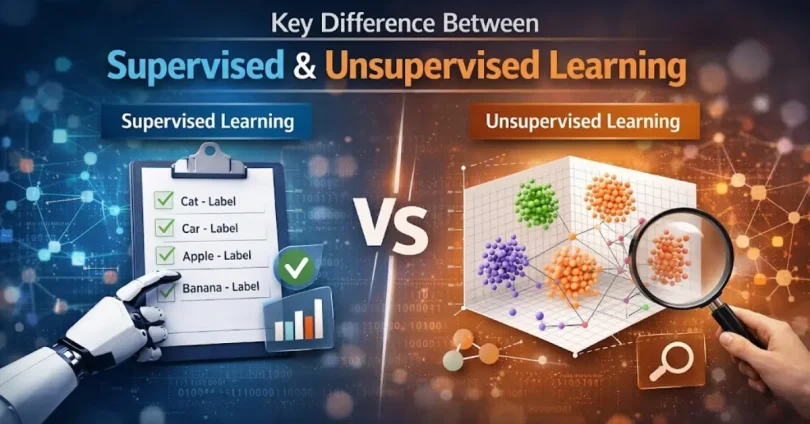

The Key Difference Between Supervised and Unsupervised Learning is one of the first things anyone should understand in machine learning. These two approaches help computers learn from data, but they do it in very different ways.
In simple words, supervised learning uses labeled data, while unsupervised learning uses unlabeled data. Although that sounds simple, the real difference goes much deeper. They solve different problems, produce different outputs, require different preparation, and are highly relevant for career guidance because understanding them helps learners choose the right direction in data science and machine learning.
This guide explains the difference between supervised and unsupervised learning in a clear, user-friendly way. You will also learn why this distinction matters, when to use each method, and how businesses and beginners can choose the right one.
Table of Contents
Why This Difference Matters
Understanding the difference between supervised and unsupervised learning is relevant because machine learning is now used in search engines, recommendation systems, fraud detection, healthcare, finance, e-commerce, and marketing.
If you choose the wrong learning approach, you may:
- waste time preparing the wrong data
- train a model that does not solve your real problem
- get confusing or low-value results
- spend more money on labeling than necessary
That is why this topic is not just academic. It is practical, relevant, and important for students, developers, analysts, and business owners.
What Is Supervised Learning?
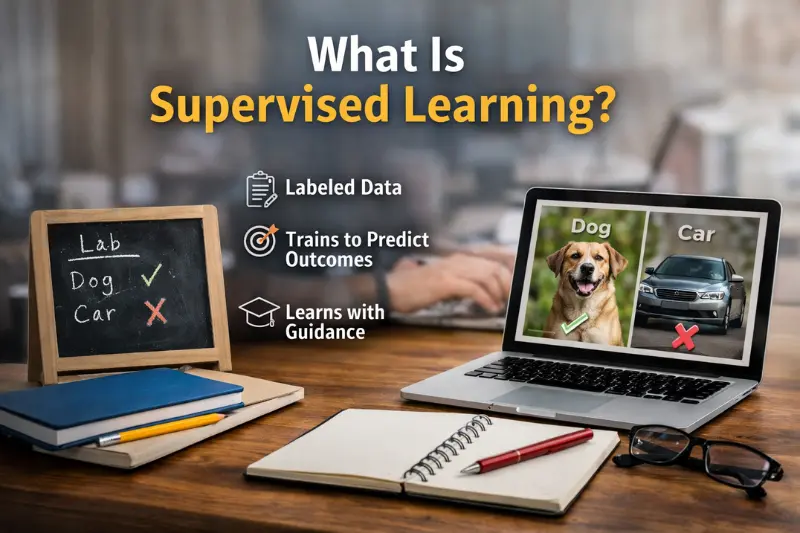
Supervised learning is a type of machine learning where the model learns from labeled data.
This means every training example includes:
- an input
- a correct output
The model studies the relationship between the input and the output. Then it uses that pattern to predict answers for new data.
Simple example
Imagine you want to teach a machine to identify spam emails.
You give it many examples like:
- Email A → Spam
- Email B → Not Spam
- Email C → Spam
Because the correct answers are already known, the model learns with guidance. That is why it is called supervised learning.
Common supervised learning tasks
Supervised learning usually handles two main tasks:
1. Classification
Classification predicts a category or label.
Examples:
- spam or not spam
- fraud or not fraud
- sick or healthy
- cat or dog
2. Regression
Regression predicts a number or continuous value.
Examples:
- house price prediction
- sales forecasting
- temperature prediction
- delivery time estimation
What Is Unsupervised Learning?
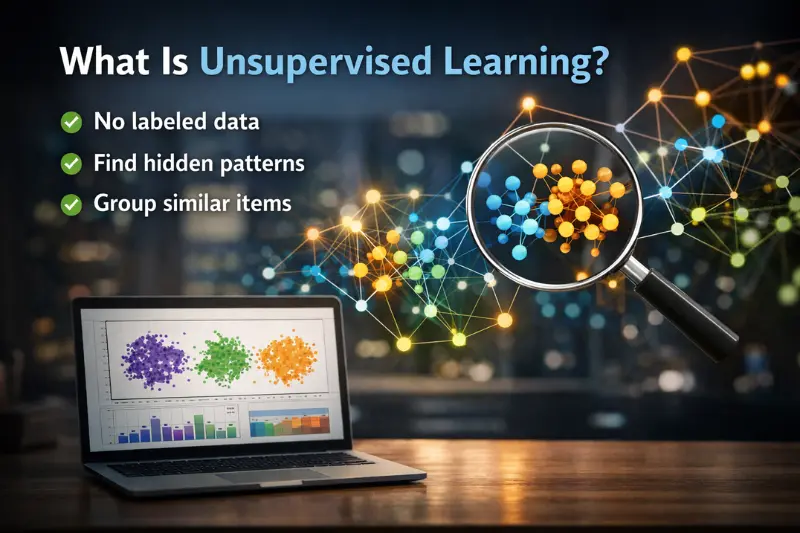
Unsupervised learning is a type of machine learning where the model works with unlabeled data.
This means the data has inputs, but no correct answers are attached. The model must explore the data on its own and find patterns, groups, relationships, or unusual points.
Simple example
Imagine you own an online store and have customer data, but no labels like “high-value customer” or “bargain buyer.”
An unsupervised model can analyze behavior and group similar customers together based on:
- purchase frequency
- order value
- browsing habits
- product preferences
No one tells the model what each group means in advance. It discovers structure by itself.
Common unsupervised learning tasks
1. Clustering
Clustering groups similar data points together.
Examples:
- customer segmentation
- grouping similar products
- organizing articles by topic
- image grouping
2. Association
Association finds relationships between items.
Examples:
- Customers who buy bread also buy butter
- People who watch one movie often watch another
3. Dimensionality Reduction
Dimensionality reduction simplifies data with many features while trying to keep the important information.
Examples:
- Reducing noise in a dataset
- compressing large feature sets
- improving visualization and preprocessing
Difference Between Supervised and Unsupervised Learning at a Glance
| Aspect | Supervised Learning | Unsupervised Learning |
|---|---|---|
| Data type | Labeled data | Unlabeled data |
| Main goal | Predict outcomes | Discover patterns |
| Human guidance | High | Lower |
| Common tasks | Classification, regression | Clustering, association, dimensionality reduction |
| Output | Predicted labels or values | Groups, patterns, hidden structures |
| Evaluation | Easier to measure | Harder to measure |
| Best for | Known problems with known outcomes | Exploring unknown patterns |
| Example | Predict house prices | Group customers by behavior |
The Core Difference Between Supervised and Unsupervised Learning
The main difference between supervised and unsupervised learning is the presence or absence of labels.
In supervised learning:
- The model learns from examples with correct answers
- The goal is to make predictions
- Success is easier to measure because you know the expected result
In unsupervised learning:
- The model learns from raw data without correct answers
- The goal is to uncover hidden patterns
- Success can be harder to judge because there is no single correct output
This is the most important concept to remember.
Real-World Examples
To understand the difference between supervised and unsupervised learning, it helps to look at real use cases.
Supervised learning examples
- Email spam detection: classify emails as spam or not spam
- Medical diagnosis support: predict disease risk from patient data
- Credit scoring: estimate the likelihood of loan default
- Price prediction: estimate house or product prices
- Sentiment analysis: classify reviews as positive, negative, or neutral
Unsupervised learning examples
- Customer segmentation: group buyers by habits and interests
- Recommendation engines: find relationships between products or content
- Anomaly detection: spot unusual patterns in system activity
- Topic discovery: group articles or documents by similarity
- Image clustering: Organize similar images together
Why Supervised Learning Is Useful
Supervised learning is powerful when you already know what you want to predict.
Benefits of supervised learning
- gives clear and practical predictions
- works well for business decisions
- easier to evaluate using metrics
- useful for automation and forecasting
- ideal when historical labeled data is available
Limitations of supervised learning
- requires labeled data, which can be expensive and slow to create
- depends heavily on data quality
- may perform poorly when the real world changes
- can miss hidden patterns outside the label structure
Why Unsupervised Learning Is Useful
Unsupervised learning is useful when you do not know the answer in advance and want the machine to explore the data for insights.
Benefits of unsupervised learning
- works with raw, unlabeled data
- helps discover patterns humans may miss
- useful for exploration and early-stage analysis
- supports segmentation and pattern discovery
- can reveal opportunities before prediction models are built
Limitations of unsupervised learning
- outputs can be harder to interpret
- Results may not always be meaningful
- Evaluation is less straightforward
- may require expert review to confirm value
Which One Is More Relevant Today?
Both are relevant, but in different ways.
Supervised learning is highly relevant when:
- Businesses want predictions
- historical outcomes exist
- Teams need measurable performance
- Automation depends on known labels
Unsupervised learning is highly relevant when:
- Data is large and messy
- Labels do not exist, yet
- Teams want to explore user behavior
- Pattern discovery matters more than direct prediction
In modern machine learning workflows, both methods often work together. A company may first use unsupervised learning to discover customer groups and then apply supervised learning to predict which group is most likely to convert or churn.
That is one reason the difference between supervised and unsupervised learning remains so relevant today.
How to Choose Between Supervised and Unsupervised Learning
A lot of articles explain definitions, but not the decision process. Here is the practical way to choose.
Use supervised learning if:
- You have labeled data
- You want to predict a known outcome
- You need clear performance metrics
- Your problem is classification or regression
Use unsupervised learning if:
- You only have raw or unlabeled data
- You want to explore hidden patterns
- You need clustering or segmentation
- You are still trying to define the problem
Ask yourself these questions
- Do I have the correct answers in my training data?
If yes, supervised learning may be the better fit. - Am I predicting something specific or exploring patterns?
Prediction usually points to supervised learning. Exploration often points to unsupervised learning. - Can I afford to label the data?
If labeling is expensive or unrealistic, unsupervised learning may be more practical. - Do I need a measurable business outcome or a deeper understanding of the data?
This often decides the direction.
Evaluation: A Difference Many Articles Skip
One of the most important differences is how these models are evaluated.
Supervised learning evaluation
Because supervised learning has correct answers, you can measure how well the model performs using metrics like:
- accuracy
- precision
- recall
- F1-score
- mean squared error
This makes supervised learning easier to test and improve.
Unsupervised learning evaluation
Unsupervised learning does not have obvious correct answers, so evaluation is more complex. You may need to judge it using:
- cluster quality
- business usefulness
- visual separation
- human interpretation
- downstream performance in later tasks
This is a major practical difference. It affects how teams validate results and decide whether a model is successful.
Common Misunderstandings
Many people misunderstand the difference between supervised and unsupervised learning. Let’s clear up a few myths.
Myth 1: Supervised learning is always better
Not true. It is better only when labeled data exists and prediction is the goal.
Myth 2: Unsupervised learning is easy
Not true. It may avoid labeling, but interpreting the output can be harder.
Myth 3: Unsupervised learning does not need human involvement
Not true. Humans still need to review whether the patterns are meaningful.
Myth 4: These methods never work together
Not true. Many real systems combine both.
Supervised vs Unsupervised Learning in Business
Here is a practical business view.
In e-commerce
- Supervised learning: predict whether a customer will buy
- Unsupervised learning: group customers by shopping behavior
In banking
- Supervised learning: predict loan default
- Unsupervised learning: detect unusual transaction patterns
In healthcare
- Supervised learning: predict disease outcome
- Unsupervised learning: find hidden patient groups with similar symptoms
In marketing
- Supervised learning: predict click-through rate
- Unsupervised learning: segment audiences into buyer personas
This makes the difference between supervised and unsupervised learning highly relevant for real decision-making, not just classroom theory.
Can You Use Both Together?
Yes. In fact, many advanced machine learning workflows use both.
A team might:
- start with unsupervised learning to explore the dataset
- identify useful clusters or patterns
- create labels from those findings
- train a supervised learning model for future prediction
This leads to related approaches such as semi-supervised learning, where a model uses a mix of labeled and unlabeled data.
This matters because real-world data is rarely perfect. Sometimes you have a small labeled set and a large unlabeled set. In that case, combining methods can be more practical than choosing only one.
A Simple Analogy to Remember
Here is a human-friendly way to remember the difference.
Supervised learning
It is like learning with an answer key.
You practice questions, check the correct answers, and improve over time.
Unsupervised learning
It is like entering a room full of mixed objects and sorting them without instructions.
You notice patterns and create groups based on similarities.
That is the simplest way to understand the difference between supervised and unsupervised learning.
Final Thoughts
The difference between supervised and unsupervised learning is not just about labeled and unlabeled data. It is about the goal, the workflow, the output, the evaluation method, and the kind of problem you want to solve.
Choose supervised learning when you want accurate predictions from labeled data. Choose unsupervised learning when you want to explore raw data and uncover hidden patterns.
Both approaches are valuable. Both are relevant. And both play a major role in modern machine learning.
If you understand where each one fits, you can make better technical decisions, ask better questions, and build smarter systems.
FAQs
What is the main difference between supervised and unsupervised learning?
The main difference is that supervised learning uses labeled data, while unsupervised learning uses unlabeled data.
What is an example of supervised learning?
Spam detection, house price prediction, and medical diagnosis support are common examples.
What is an example of unsupervised learning?
Customer segmentation, clustering similar articles, and anomaly detection are common examples.
Which is easier to evaluate?
Supervised learning is usually easier to evaluate because it has known correct outputs.
Which one is better for raw data?
Unsupervised learning is usually better for exploring raw data without labels.
Can supervised and unsupervised learning be used together?
Yes, many real-world machine learning systems combine both approaches.
Why is this topic relevant today?
It is relevant because businesses and developers use both methods in AI, analytics, automation, healthcare, finance, and marketing.
YOU MAY ALSO LIKE:
High Salary Career Options in Medical Without NEET
FYKI Full Form – Meaning, Usage, Examples, And When To Use It
Digital Storytelling Tools: The Complete Guide for Teachers, Students, and Online Learning