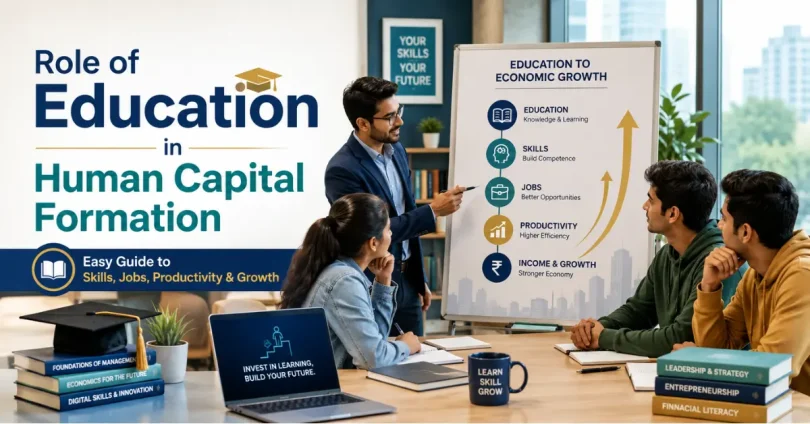

Education plays a major role in human capital formation because it improves people’s knowledge, skills, productivity, confidence, and ability to earn a better income. In simple words, education turns people into valuable human resources who can contribute to their own growth and the development of society.
If you are wondering what is the role of education in human capital formation, the direct answer is this: education develops human abilities and makes people more productive, employable, innovative, and socially responsible.
Human capital is not built only by physical strength or natural talent. It grows when people learn, train, think critically, follow proper career guidance, and apply knowledge in real life. That is why education is one of the strongest investments a country can make.
Table of Contents
Direct Answer: Role of Education in Human Capital Formation
| Key Point | Simple Explanation |
|---|---|
| Main Role | Education improves knowledge, skills, values, and productivity. |
| Human Capital Meaning | Human capital means the abilities, knowledge, health, and skills of people. |
| Economic Impact | Educated people work better, earn more, and support economic growth. |
| Social Impact | Education reduces poverty, inequality, unemployment, and social backwardness. |
| Unique Role | Education prepares people for future jobs, digital skills, innovation, and lifelong learning. |
| Best Exam Answer | Education helps in human capital formation by making people skilled, productive, employable, aware, and capable of contributing to national development. |
What Is Human Capital Formation?
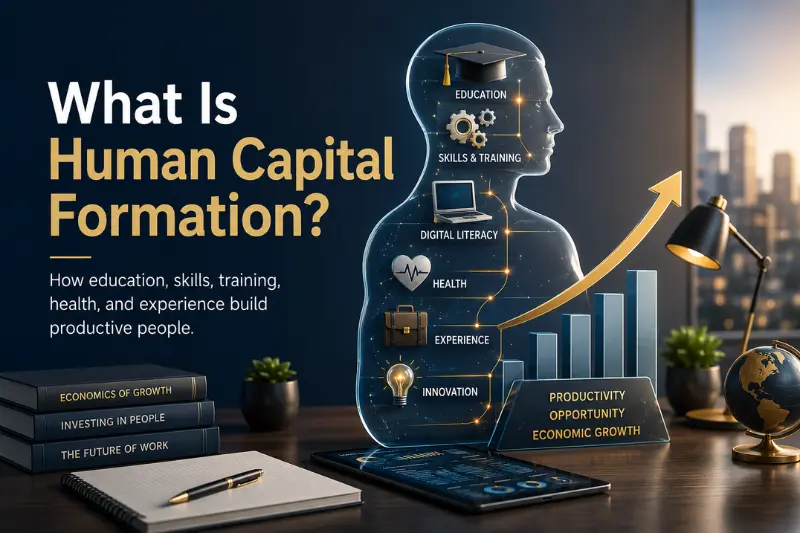
Human capital formation means the process of improving the quality of people through education, training, health care, experience, and skill development.
Just like machines, buildings, and tools help production, educated and skilled people also help a country grow. The difference is that human capital exists inside people. It includes:
- Knowledge
- Skills
- Experience
- Creativity
- Health awareness
- Work efficiency
- Decision-making ability
- Moral and social values
A country with strong human capital can produce better goods, provide better services, use technology effectively, and improve living standards.
Why Is Education Important for Human Capital Formation?
Education is important because it builds the foundation of a person’s future. It teaches people how to think, communicate, solve problems, and work in different fields.
When people receive quality education, they become more useful for the economy. They can become teachers, doctors, engineers, entrepreneurs, skilled workers, researchers, and responsible citizens.
This is why education is not just personal learning. It is also a national investment.
1. Education Develops Knowledge and Skills
The first role of education in human capital formation is skill development. Education teaches basic and advanced skills that people need in daily life and work.
For example, schools teach reading, writing, mathematics, communication, and discipline. Higher education and vocational training teach technical, professional, and job-related skills.
These skills help people:
- Understand work better
- Use tools and technology
- Communicate clearly
- Solve problems
- Make better decisions
- Adapt to new jobs
Without education, many people may have natural talent but no proper direction to use it.
2. Education Increases Productivity
Productivity means the ability to produce more and better output in less time. Educated people usually work more efficiently because they understand methods, systems, tools, and technology.
For example, an educated farmer can use modern farming techniques. An educated worker can operate machines safely. A trained nurse can provide better health care. A skilled software developer can create digital solutions.
This shows that education improves the quality of work. When workers become more productive, businesses grow, income increases, and the economy becomes stronger.
3. Education Improves Employment Opportunities
A major reason why education matters in human capital formation is that it improves employment opportunities.
Employers usually prefer people who have knowledge, discipline, communication skills, and practical abilities. Education helps people qualify for better jobs and stable careers.
It also opens doors to:
- Government jobs
- Private sector jobs
- Freelancing
- Entrepreneurship
- Technical work
- Professional careers
- Digital careers
In today’s world, education is not limited to degrees. Skill-based education, online courses, vocational training, and digital learning also help people become employable.
4. Education Raises Income and Living Standards
Education can increase a person’s earning capacity. When people have better skills and knowledge, they can get better-paying jobs or start successful businesses.
Higher income improves living standards. It helps people afford better food, housing, health care, education for children, and a safer lifestyle.
This is one reason education helps reduce poverty. It gives people the ability to change their economic condition through learning and hard work.
5. Education Encourages Innovation and Creativity
Another important role of education in human capital formation is innovation. Educated people can think creatively, ask questions, and find better solutions to problems.
Innovation is important in every field, including:
- Science
- Technology
- Medicine
- Agriculture
- Business
- Education
- Engineering
- Digital media
Countries grow faster when their people can create new ideas, improve old methods, and use technology wisely. Education builds this creative and research-based mindset.
6. Education Supports Economic Growth
When many people in a country become educated and skilled, the whole economy benefits. A strong education system creates a strong workforce.
Educated human capital helps economic growth by:
- Increasing production
- Improving work quality
- Supporting industries
- Reducing unemployment
- Encouraging entrepreneurship
- Attracting investment
- Improving national income
This is why countries that invest in education often become more competitive and developed over time.
7. Education Reduces Poverty and Inequality
Education gives people from poor or disadvantaged backgrounds a chance to improve their lives. It can reduce the gap between the rich and the poor by giving everyone access to knowledge and skills.
A child from a low-income family can become a doctor, teacher, engineer, business owner, or skilled professional through education.
However, this only happens when education is accessible, affordable, and useful. Simply opening schools is not enough. Students must receive quality learning, trained teachers, and practical skills.
8. Education Improves Health Awareness
Human capital is not only about jobs and income. Health is also a part of human capital.
Education helps people understand hygiene, nutrition, disease prevention, mental health, and healthy lifestyle choices. Educated people are more likely to make informed decisions about their health and family well-being.
A healthy person can work better, learn better, and contribute more effectively to society. That is why education and health together build strong human capital.
9. Education Builds Responsible Citizens
Education also develops values, discipline, responsibility, and social awareness. It teaches people about rights, duties, laws, equality, cooperation, and respect.
A responsible citizen contributes to society in positive ways. Educated citizens are more likely to:
- Follow laws
- Vote responsibly
- Respect others
- Support social development
- Protect the environment
- Fight against injustice
- Help their communities
This social role of education is often ignored, but it is very important in human capital formation.
10. Education Prepares People for Future Jobs
One unique role of education in human capital formation is future readiness. The job market is changing quickly because of technology, artificial intelligence, automation, and digital platforms.
Modern education should prepare people for:
- Digital skills
- Online work
- Artificial intelligence tools
- Data literacy
- Communication skills
- Critical thinking
- Adaptability
- Lifelong learning
A person who keeps learning can survive and grow in a changing economy. This is why education should not stop after school or college. Learning must continue throughout life.
11. Quality of Education Matters More Than Just Attendance
A very important point is that human capital does not grow only because students attend school. Real human capital grows when students actually learn useful knowledge and skills.
For example, if students go to school but do not understand basic reading, writing, math, or problem-solving, then education will not fully build human capital.
Quality education needs:
- Trained teachers
- Updated curriculum
- Practical learning
- Digital resources
- Skill-based training
- Equal access for all students
- Safe learning environments
This is a key point many articles miss. Education must be meaningful, not just formal.
12. Education Reduces Skill Mismatch
Skill mismatch happens when people are educated but do not have the skills required by the job market. This creates unemployment even among degree holders.
To avoid this, education should connect with real career needs. Schools and colleges should teach practical skills along with theory.
Important practical skills include:
- Communication
- Computer literacy
- Problem-solving
- Teamwork
- Financial awareness
- Technical skills
- Career planning
- Entrepreneurship
When education matches market needs, human capital becomes stronger and more useful.
Examples of Education in Human Capital Formation
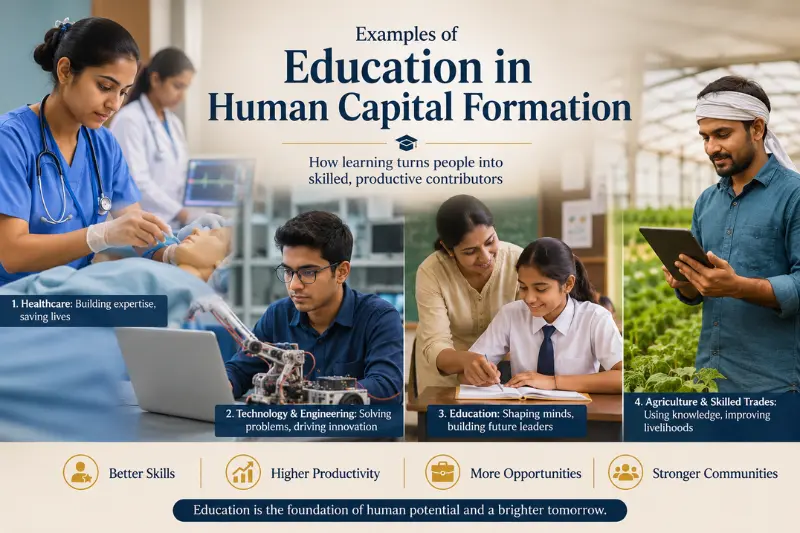
Here are some simple examples:
- A student studies medicine and becomes a doctor who treats people.
- A farmer learns modern farming and increases crop production.
- A worker learns computer skills and gets a better job.
- A teacher receives training and improves student learning.
- A young person learns business skills and starts a company.
- A nurse receives professional education and improves health services.
These examples show that education converts ordinary ability into productive human capital.
Challenges in Human Capital Formation Through Education
Education is powerful, but many challenges can reduce its impact.
Some common challenges are:
- High cost of quality education
- Lack of trained teachers
- Poor school infrastructure
- Outdated curriculum
- Digital divide
- Poverty and child labor
- Gender inequality
- Rural and urban education gaps
- Dropout problems
- Lack of career guidance
To build strong human capital, governments, schools, families, and communities must work together to solve these problems.
Best Student-Friendly Answer
Education plays an important role in human capital formation because it increases the knowledge, skills, productivity, employment opportunities, income, health awareness, and social values of people. It helps individuals become productive workers and responsible citizens. In this way, education contributes to economic growth and national development.
Conclusion
So, what is the role of education in human capital formation? The answer is simple: education develops people into skilled, knowledgeable, productive, and responsible members of society.
It improves employment, income, health awareness, innovation, social development, and economic growth. More importantly, education helps people use their abilities in the right direction.
A country cannot grow only with land, machines, or money. It needs educated, skilled, and healthy people. That is why education is the foundation of human capital formation and one of the strongest tools for national development.
FAQs
What is the role of education in human capital formation?
Education helps in human capital formation by improving knowledge, skills, productivity, employability, income, health awareness, and social responsibility.
What is human capital formation in simple words?
Human capital formation means improving the quality of people through education, training, health, and skill development so they can contribute better to society and the economy.
How does education increase productivity?
Education increases productivity by teaching people better methods, technical skills, problem-solving, communication, and the use of modern technology.
Why is education called an investment in human capital?
Education is called an investment because it improves a person’s future earning ability, work efficiency, and contribution to economic development.
How does education reduce poverty?
Education reduces poverty by helping people get better jobs, earn higher income, develop skills, and improve their living standards.
What is the link between education and economic growth?
Education builds a skilled workforce, increases productivity, supports innovation, and helps a country produce more goods and services.
Why is quality education important in human capital formation?
Quality education is important because only meaningful learning can build real skills, confidence, creativity, and job readiness.
YOU MAY ALSO LIKE:
Which of These Statements Was Implied by the Decision in Brown v. Board of Education?
How Is It Possible for Ski Jumpers to Stay in the Air So Long and How Do They Train for That?
Good Excuses to Miss Work on Short Notice – Valid Reasons and What to Say
FCI HRMS: Login, Payslip, Leave, ERS Portal, App & Employee Services