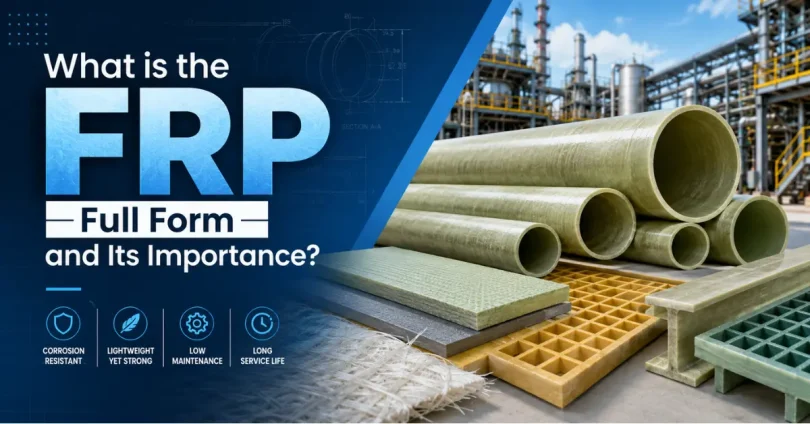

The FRP full form is Fiber Reinforced Plastic. In some engineering and construction industries, FRP is also called Fiber Reinforced Polymer. Both terms describe a strong composite material made by combining plastic resin with reinforcing fibers.
FRP is popular because it is lightweight, strong, corrosion-resistant, and easy to shape into different products. It is used in construction, chemical plants, water treatment systems, marine projects, electrical structures, storage tanks, and piping systems.
If you have seen FRP sheets, FRP panels, FRP tanks, FRP grating, or FRP pipes, they all come from the same basic material concept: a plastic base strengthened with fibers.
Table of Contents
What Is the FRP Full Form?
The FRP full form is Fiber Reinforced Plastic.
Here is the simple meaning:
- Fiber means strong reinforcing material, such as glass fiber, carbon fiber, aramid fiber, or basalt fiber.
- Reinforced means made stronger by adding support.
- Plastic means the polymer resin that holds the fibers together.
So, FRP means a plastic material that is made stronger by adding fibers. This combination creates a material that is much stronger than normal plastic and much lighter than many traditional materials like steel or concrete.
FRP Full Form in Different Industries
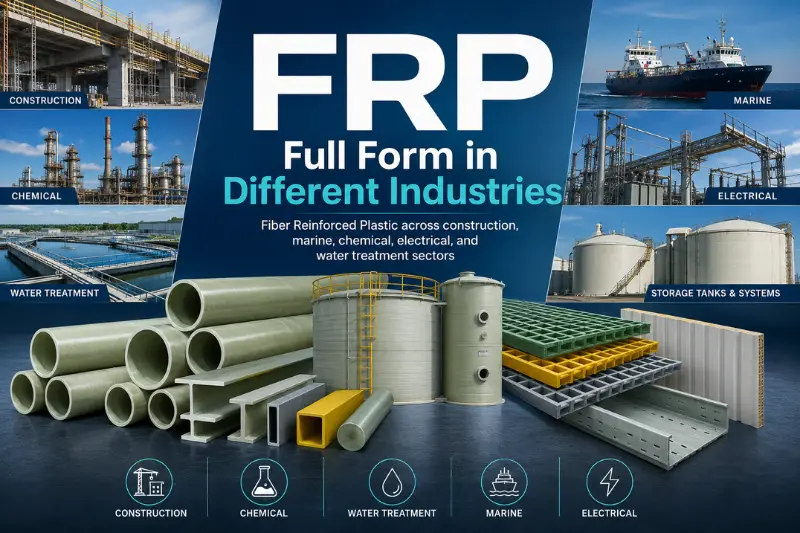
The FRP full form can have slightly different wording depending on the industry.
| Term | Meaning | Common Use |
|---|---|---|
| Fiber Reinforced Plastic | Most common full form | General industrial and commercial use |
| Fiber Reinforced Polymer | Technical engineering term | Civil engineering and composite material studies |
| Fiberglass Reinforced Plastic | Used when glass fiber is used | FRP sheets, tanks, panels, and pipes |
In most cases, when people search for FRP full form, they are looking for Fiber Reinforced Plastic.
What Is FRP Material?
FRP is a composite material. A composite material is made by combining two or more materials to create a stronger final product.
FRP mainly has two parts:
1. Reinforcing Fiber
The fiber gives FRP its strength. It helps the material handle load, pressure, bending, and impact.
Common fibers used in FRP include:
- Glass fiber
- Carbon fiber
- Aramid fiber
- Basalt fiber
2. Polymer Resin
The resin works like a binding material. It holds the fibers in place and gives the product its shape.
Common resin types include:
- Polyester resin
- Vinyl ester resin
- Epoxy resin
- Phenolic resin
The final strength, chemical resistance, and durability of FRP depend on the type of fiber and resin used.
Simple Example to Understand FRP
Think of FRP like reinforced concrete.
Concrete alone is strong, but when steel bars are added, it becomes stronger. In the same way, plastic alone is useful, but when strong fibers are added, it becomes FRP.
That is why FRP is stronger than normal plastic and more useful for industrial and construction work.
Why Is FRP Used?
FRP is used because it solves many problems found in traditional materials. Steel can rust, wood can rot, and concrete can crack. FRP resists many of these issues.
FRP is commonly used where the material needs to be:
- Strong but lightweight
- Resistant to corrosion
- Easy to install
- Low maintenance
- Long-lasting
- Non-conductive
- Suitable for wet or chemical environments
This is why FRP is widely used in industries that deal with water, chemicals, outdoor weather, and heavy-duty structures.
Types of FRP
There are different types of FRP based on the fiber used inside the material.
Glass Fiber Reinforced Plastic
Glass Fiber Reinforced Plastic is one of the most common FRP types. It is also known as GFRP or fiberglass reinforced plastic.
It is used in:
- FRP sheets
- FRP tanks
- FRP pipes
- FRP panels
- Boat parts
- Industrial platforms
- Cable trays
GFRP is popular because it is affordable, strong, and corrosion-resistant.
Carbon Fiber Reinforced Plastic
Carbon Fiber Reinforced Plastic is also called CFRP. It is stronger and lighter than many other FRP types, but it is more expensive.
It is used in:
- Aerospace parts
- Sports equipment
- High-performance vehicles
- Structural strengthening
- Advanced engineering products
CFRP is best for projects where low weight and high strength are very important.
Aramid Fiber Reinforced Plastic
Aramid Fiber Reinforced Plastic is known for impact resistance and toughness.
It is used in:
- Protective equipment
- Aerospace applications
- Marine parts
- Impact-resistant structures
This type of FRP performs well where shock absorption and strength are needed.
Basalt Fiber Reinforced Plastic
Basalt Fiber Reinforced Plastic is made using basalt fibers. It offers good resistance to heat, chemicals, and weather.
It is used in:
- Construction reinforcement
- Marine structures
- Industrial equipment
- High-temperature areas
Basalt FRP is growing in popularity because it offers a balance between strength and durability.
Common FRP Products
FRP is used to make many products for homes, industries, and construction projects.
Common FRP products include:
- FRP sheets
- FRP panels
- FRP pipes
- FRP tanks
- FRP gratings
- FRP cable trays
- FRP ladders
- FRP doors
- FRP roofing sheets
- FRP handrails
- FRP platforms
- FRP cooling tower parts
Each product is designed for a specific use, but the main benefit remains the same: strength, durability, and resistance to corrosion.
What Is FRP Pipe?
FRP pipe is a pipe made from fiber-reinforced plastic. It is commonly used to carry water, chemicals, wastewater, seawater, oil, and other fluids.
FRP pipes are useful because they do not rust like metal pipes. They are also lightweight, which makes transportation and installation easier.
FRP pipes are often used in:
- Water supply systems
- Sewage systems
- Chemical plants
- Oil and gas industries
- Desalination plants
- Industrial drainage
- Power plants
- Wastewater treatment plants
The main advantage of FRP pipe is that it can handle corrosive environments better than many traditional pipe materials.
FRP vs GRP: What Is the Difference?
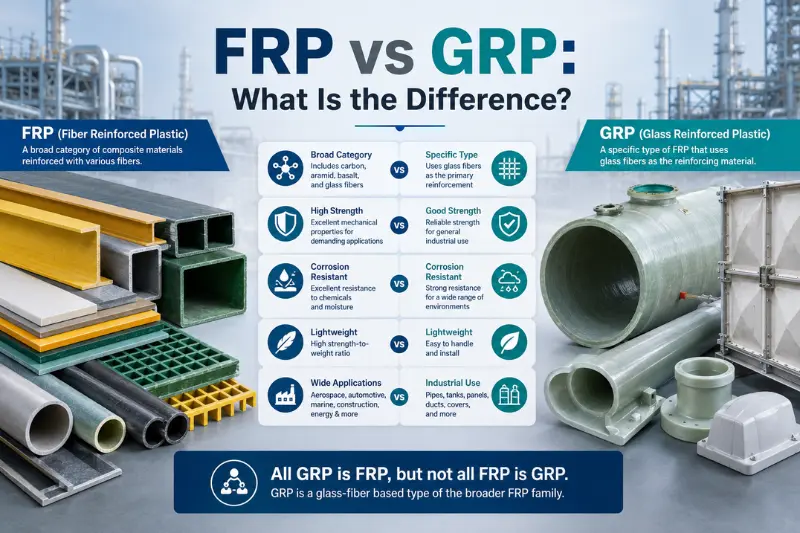
Many people confuse FRP and GRP.
The main difference is simple:
- FRP means Fiber Reinforced Plastic.
- GRP means Glass Reinforced Plastic.
GRP is actually a type of FRP. When glass fiber is used as the reinforcement, the material is called GRP.
So, all GRP can be considered FRP, but not all FRP is GRP. FRP may use glass fiber, carbon fiber, aramid fiber, or basalt fiber.
FRP vs Steel, PVC, Wood, and Concrete
FRP is often compared with traditional materials because it is used as an alternative in many industries.
| Material | Weight | Corrosion Resistance | Maintenance | Common Issue |
|---|---|---|---|---|
| FRP | Lightweight | Excellent | Low | Higher initial cost |
| Steel | Heavy | Poor without coating | Medium to high | Rust |
| PVC | Lightweight | Good | Low | Lower strength |
| Wood | Medium | Poor | High | Rot and termite damage |
| Concrete | Very heavy | Medium | Medium | Cracking |
FRP is not always the cheapest material at the start, but it can save money over time because it needs less maintenance and lasts longer in harsh conditions.
Advantages of FRP
FRP has many benefits that make it useful for different industries.
Lightweight
FRP is much lighter than steel and concrete. This makes it easier to transport, lift, and install.
Corrosion-Resistant
FRP does not rust like steel. It performs well in wet, salty, chemical, and outdoor environments.
Strong and Durable
FRP has a high strength-to-weight ratio. It can handle stress while staying lightweight.
Low Maintenance
FRP does not need frequent painting, coating, or rust protection. This reduces maintenance costs.
Non-Conductive
FRP does not conduct electricity like metal. That makes it useful for electrical areas, cable trays, ladders, and platforms.
Design Flexibility
FRP can be molded into many shapes and sizes. It can be used for sheets, tanks, pipes, panels, and custom industrial parts.
Long Service Life
FRP can last for many years when properly designed, manufactured, and installed.
Disadvantages of FRP
FRP is useful, but it also has some limitations.
- It can cost more than some traditional materials at the beginning.
- Poor-quality FRP may crack or fade in harsh sunlight.
- It needs proper installation for best performance.
- Some FRP types may not be suitable for very high-temperature applications.
- Repairing FRP may need skilled workers.
These disadvantages do not mean FRP is a bad material. They simply mean the right FRP type should be selected for the right application.
Where Is FRP Used?
FRP is used in many industries because it is strong, lightweight, and resistant to corrosion.
Construction
FRP is used in panels, rebars, roofing sheets, handrails, platforms, and structural strengthening.
Chemical Industry
FRP tanks, pipes, and ducts are used to handle corrosive chemicals safely.
Water Treatment
FRP is used in wastewater plants, water tanks, filtration systems, and sewage pipelines.
Marine Industry
FRP works well in boats, docks, seawater pipes, and coastal structures because it resists saltwater corrosion.
Electrical Industry
FRP cable trays, ladders, and poles are used because FRP is non-conductive and safe around electrical systems.
Automotive and Transport
FRP is used in vehicle panels, body parts, and lightweight components.
Is FRP Waterproof?
Yes, FRP is generally waterproof when it is manufactured properly. It does not absorb water like wood, and it does not rust like steel.
This is why FRP is used in:
- Water tanks
- Bathroom panels
- Roofing sheets
- Marine structures
- Swimming pool areas
- Wastewater systems
However, the waterproof quality depends on the resin, coating, and manufacturing process.
Is FRP Fire-Resistant?
FRP can be made fire-retardant by using special resin and additives. Standard FRP is not always fully fireproof, but fire-retardant FRP products are available for areas where fire safety is important.
Before using FRP in fire-sensitive areas, always check the product grade and fire rating.
How Long Does FRP Last?
FRP can last for decades when it is made with quality materials and installed correctly. Its lifespan depends on:
- Resin quality
- Fiber type
- UV exposure
- Chemical exposure
- Installation method
- Maintenance routine
- Environmental conditions
In many industrial and outdoor uses, FRP lasts longer than untreated steel, wood, and ordinary plastic.
Is FRP Better Than Steel?
FRP can be better than steel in certain conditions, especially where corrosion is a major problem.
FRP is better when you need:
- Lightweight material
- Corrosion resistance
- Low maintenance
- Electrical insulation
- Easy installation
- Long-term durability in wet or chemical areas
Steel may still be better where very high load-bearing strength, welding, or extreme heat resistance is required. The best choice depends on the project.
How to Choose the Right FRP Product
Before buying FRP, check these points:
- What will the FRP product be used for?
- Will it face chemicals, water, sunlight, or heat?
- Does it need to carry heavy loads?
- Is fire resistance required?
- What resin type is used?
- What fiber type is used?
- Is the manufacturer reliable?
- Does the product meet industry standards?
Choosing the right FRP product helps you avoid performance issues later.
Final Thoughts
The FRP full form is Fiber Reinforced Plastic, and it is one of the most useful modern composite materials. It combines the strength of fibers with the flexibility of plastic resin.
FRP is lightweight, strong, corrosion-resistant, low-maintenance, and suitable for many industries. From FRP pipes and tanks to panels, gratings, sheets, and structural parts, this material offers practical benefits for both industrial and commercial use.
If you need a material that can handle moisture, chemicals, outdoor weather, and long-term use, FRP can be a smart choice.
FAQs About FRP Full Form
What is the FRP full form?
The FRP full form is Fiber Reinforced Plastic. It is a composite material made with plastic resin and strong reinforcing fibers.
What is FRP made of?
FRP is made of reinforcing fibers and polymer resin. The fibers provide strength, while the resin gives shape and protection.
Is FRP the same as fiberglass?
Not exactly. Fiberglass is usually a type of FRP made with glass fibers. FRP can also use carbon, aramid, or basalt fibers.
What is FRP pipe used for?
FRP pipe is used for water supply, wastewater systems, chemical transport, oil and gas fluids, seawater lines, and industrial drainage.
Is FRP stronger than plastic?
Yes, FRP is much stronger than normal plastic because it has reinforcing fibers inside it.
Is FRP waterproof?
Yes, FRP is generally waterproof and works well in wet and humid environments.
Does FRP rust?
No, FRP does not rust like steel. This is one of its biggest advantages.
Is FRP costly?
FRP may cost more at the beginning, but it can save money over time because it needs less maintenance and lasts longer in harsh environments.
What is the difference between FRP and GRP?
FRP means Fiber Reinforced Plastic. GRP means Glass Reinforced Plastic. GRP is a type of FRP that uses glass fiber.
Where is FRP commonly used?
FRP is commonly used in construction, chemical plants, marine projects, water treatment, electrical systems, automotive parts, tanks, pipes, and industrial platforms.
YOU MAY ALSO LIKE:
FYKI Full Form – Meaning, Email Use, Examples, and FYI Difference
APBCR Full Form – Meaning in Banking, Uses, and Simple Explanation
FCI HRMS: Login, Payslip, Leave, ERS Portal, App & Employee Services
How Is It Possible for Ski Jumpers to Stay in the Air So Long and How Do They Train for That?