

ICYMI meaning is simple: ICYMI stands for “in case you missed it.” People use it when they want to reshare something that others may not have seen the first time. It is common in text messages, social media captions, email subject lines, newsletters, news posts, and workplace chats. Think of it as a friendly little signpost that says, “Hey, this might be worth your attention.”
The phrase is useful because online life moves fast. A post can disappear under hundreds of updates, an email can get buried in a crowded inbox, and a group chat can move faster than a busy highway. That is where ICYMI comes in. Instead of sounding annoyed that someone missed something, it usually sounds casual, helpful, and low-pressure.
For example, someone might write, “ICYMI, the meeting has moved to 2 PM,” or “ICYMI: our new guide is live.” In both cases, the sender is not necessarily blaming anyone. They are simply making sure the information gets another chance to be seen.
The main thing to remember is this: ICYMI is used for information that already exists or was already shared. It is not usually the best choice for brand-new information. If something has never been announced before, saying ICYMI may feel a little odd because there was nothing to miss yet.
Table of Contents
What Does ICYMI Stand For?

ICYMI stands for “in case you missed it.” Each letter comes from the first letter of the phrase: I for “in,” C for “case,” Y for “you,” M for “missed,” and I for “it.” The full phrase is often used when someone wants to bring attention back to a post, update, announcement, link, photo, video, article, sale, reminder, or conversation.
The icymi meaning is especially connected to digital communication. People do not want to write long phrases every time they send quick updates, so abbreviations help them save time. Instead of typing five words, they type five letters. That might not sound like a big difference, but in fast-paced online spaces, small shortcuts become habits very quickly.
Here is the key difference between ICYMI and a normal announcement. A normal announcement says, “Here is something new.” An ICYMI message says, “This was already shared, but you may not have seen it.” That small difference matters because it changes the tone of the message.
For example, “Our podcast episode is live” feels like a first announcement. But “ICYMI: our podcast episode is live” suggests the episode was already posted earlier and is being shared again for people who missed it. This makes ICYMI useful for reminders, reposts, recaps, and follow-ups.
Where People Use ICYMI Today
People use ICYMI almost anywhere short digital messages appear. You can see it in private texts, group chats, social media captions, email subject lines, newsletters, news roundups, Slack messages, Discord posts, LinkedIn updates, and brand promotions. The icymi meaning stays mostly the same across all of these places, but the tone can change depending on the platform.
In a text message, ICYMI usually feels personal and casual. In an email subject line, it can feel like a reminder. On social media, it often acts like a second push for content that might have been buried by the algorithm. In a professional message, it can sound polite if used carefully.
What makes ICYMI so popular is that it solves a real communication problem. People miss things all the time. They scroll quickly, skim messages, ignore notifications, or open an app hours after something was posted. Saying ICYMI lets the sender repeat information without making the reader feel called out.
Still, context matters. A friend can write “ICYMI, I posted vacation photos” and it sounds natural. A manager writing “ICYMI, you missed the deadline” might sound passive-aggressive. The phrase itself is neutral, but the message around it decides whether it feels friendly or sharp.
ICYMI in Text Messages
In texting, ICYMI is usually used to share something useful, funny, interesting, or important that the other person may not have seen. The icymi meaning in texting is close to saying, “Just making sure you saw this.” It works well when sending links, reminders, screenshots, plans, updates, or group chat details.
For example, you might text a friend, “ICYMI, the concert tickets go on sale tomorrow.” You could also say, “ICYMI, Sarah changed the dinner reservation to 7:30.” In both examples, the phrase keeps the message short while adding helpful context.
The best thing about ICYMI in texting is that it softens the reminder. Instead of writing, “You didn’t see this,” which can sound rude, ICYMI feels more relaxed. It gives the other person room to say, “Oh, thanks, I missed that.”
However, do not overuse it. If every message starts with ICYMI, it can begin to feel robotic or annoying. Use it when there is a real chance the person missed something and when the information is genuinely worth repeating.
ICYMI on Social Media
On social media, ICYMI is often used to reshare posts, highlight updates, remind followers about events, or bring attention to content that did not get enough visibility the first time. The icymi meaning on social platforms is usually, “This already happened or was posted, but it is still worth seeing.”
For example, a creator might write, “ICYMI: I shared my full skincare routine yesterday.” A brand might post, “ICYMI, our summer sale ends tonight.” A news account may use it before a recap, such as “ICYMI: here are the biggest stories from the weekend.”
The reason ICYMI works so well on social media is simple: feeds are crowded. Algorithms do not show every post to every follower. Even loyal followers can miss updates. Using ICYMI gives creators, publishers, and businesses a natural way to repeat important content without sounding like they are spamming people.
It also works well in captions because it immediately tells the reader why the post is being shared again. Instead of making people wonder, “Didn’t I already see this?” the phrase explains the repost upfront.
ICYMI in Emails and Newsletters
In email, ICYMI often appears in subject lines, newsletter sections, sales reminders, event follow-ups, and content recaps. The icymi meaning in email is usually, “You may have missed our previous message, so here is another chance to see it.” It can be effective because inboxes are messy, and many people miss emails even when they meant to read them.
Examples include “ICYMI: Registration closes tonight,” “ICYMI: Our most-read article of the week,” or “ICYMI: Your discount code expires soon.” These subject lines create a sense of helpful urgency without being too aggressive.
For newsletters, ICYMI is especially useful in roundup sections. A brand, blogger, or publisher can use it to highlight popular content from earlier in the week. This makes the email feel useful instead of repetitive.
The warning is that marketers should not abuse ICYMI. If every email says ICYMI, readers may stop trusting it. It works best when the content was actually shared before or when the reminder is genuinely valuable.
How to Pronounce ICYMI
Most people do not pronounce ICYMI as a normal word. They either read it in their head as “in case you missed it” or say the individual letters: I-C-Y-M-I. Because it is mainly used in writing, pronunciation is not something most people worry about in daily conversation.
You may occasionally hear someone say the letters out loud in a meeting or podcast, but that is not as common as simply saying the full phrase. For example, in speech, most people would say, “In case you missed it, the schedule changed,” instead of saying, “I-C-Y-M-I, the schedule changed.”
This is one reason the icymi meaning can confuse people at first. Unlike LOL, which some people say out loud as “lol,” ICYMI does not naturally roll off the tongue. It looks like internet shorthand, and that is exactly what it is.
So, the easiest rule is this: when writing, ICYMI is fine. When speaking, say “in case you missed it.” That keeps your message clear and natural.
Is ICYMI an Acronym, Abbreviation, or Initialism?
People often call ICYMI an acronym, but technically, it is closer to an initialism. An acronym is usually pronounced as a word, like NASA. An initialism is usually pronounced letter by letter, like FBI or CEO. Since most people do not say ICYMI as one word, it fits better under initialism.
That said, in everyday conversation, many people use the word acronym loosely for almost any shortened phrase made from first letters. So if someone says, “ICYMI is an acronym,” most people will understand what they mean. It is not a big mistake in casual writing.
For SEO and clarity, though, it helps to explain both. ICYMI is a digital abbreviation and, more specifically, an initialism. Its full form is “in case you missed it.” This gives readers a more complete understanding and helps avoid confusion.
The important part is not the label. The important part is knowing how to use it naturally. Whether someone calls it an acronym, abbreviation, or initialism, the icymi meaning does not change.
Why People Use ICYMI Online
People use ICYMI because the internet moves too fast. Posts vanish under newer posts. Emails sit unread. Group chats pile up. News breaks, trends shift, and updates get buried before many people even open their phones. ICYMI is a simple way to bring something back without making a huge announcement again.
It also helps the sender sound considerate. Instead of saying, “You missed this,” they can say, “ICYMI.” That tiny difference makes the message feel more polite. It assumes the person may have missed something by accident, not because they ignored it.
Another reason people use it is visibility. Creators, brands, writers, and businesses often spend time making content that only a small part of their audience sees. Sharing it again with ICYMI gives the content a second life. It is like placing a bookmark in a busy room and saying, “This is still worth looking at.”
The icymi meaning also carries a subtle sense of relevance. It tells the reader the content matters enough to be repeated. That is why it is common in headlines, social captions, product launches, limited-time offers, and weekly recaps.
ICYMI Meaning by Context
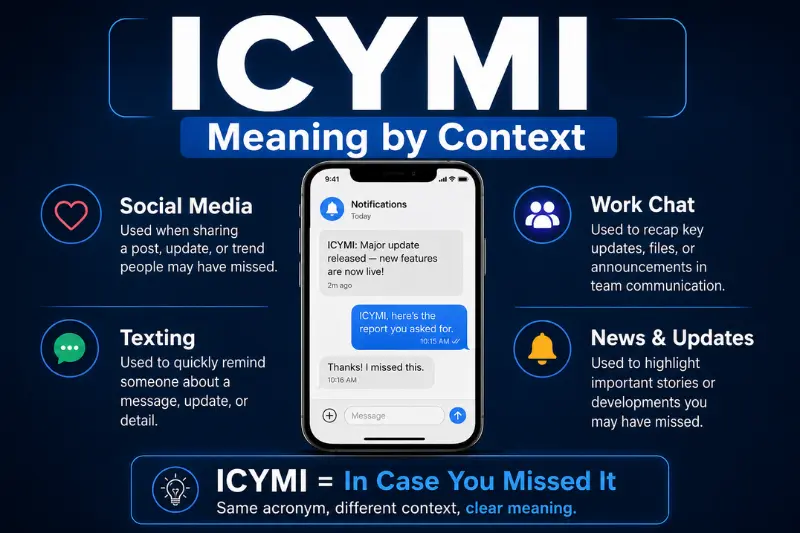
The icymi meaning is always based on the same phrase, but the feeling changes depending on context. In a personal text, it may feel friendly. In a marketing email, it may feel promotional. In a workplace message, it may feel helpful or slightly pointed, depending on how it is written.
This is where many people get confused. They know what ICYMI stands for, but they are not sure whether it sounds casual, professional, urgent, or rude. The truth is that ICYMI is flexible. It is not automatically rude, but it can become rude if paired with the wrong wording.
For example, “ICYMI, here are the notes from yesterday’s call” sounds helpful. But “ICYMI, I already explained this” sounds irritated. Same abbreviation, completely different tone.
That is why the words after ICYMI matter. Use it to point people toward useful information, not to shame them for missing something.
Casual ICYMI Meaning
In casual conversations, ICYMI feels light and friendly. Friends use it to share photos, plans, gossip, memes, videos, announcements, or updates. The casual icymi meaning is close to saying, “You might want to see this.”
Examples include “ICYMI, I finally adopted a dog,” “ICYMI, the trailer dropped,” or “ICYMI, Jake posted the funniest video.” These messages do not feel formal or serious. They feel like someone is keeping you in the loop.
Casual ICYMI also works well when people are part of a group chat but not constantly active. If someone missed dozens of messages, a simple “ICYMI, we’re meeting at 6” saves them from scrolling through everything.
The main rule is to keep it natural. If you would normally say, “Just so you saw this,” then ICYMI probably works.
Professional ICYMI Meaning
In professional communication, ICYMI can be useful, but it needs a little care. The professional icymi meaning is usually, “Sharing this again in case it was missed.” It can work in team emails, Slack messages, project updates, company announcements, and LinkedIn posts.
Good professional examples include “ICYMI, the updated project brief is in the shared folder,” or “ICYMI, today’s meeting notes are now available.” These sound helpful because they focus on the information, not the person who missed it.
However, avoid using ICYMI when emotions are high, deadlines were ignored, or accountability is involved. In those cases, direct language is better. For example, instead of writing “ICYMI, the report was due yesterday,” write “The report was due yesterday. Can you send an update by 3 PM?”
Used well, ICYMI keeps professional messages short and polite. Used badly, it can sound passive-aggressive.
Marketing ICYMI Meaning
In marketing, ICYMI is used to give offers, announcements, launches, or content a second chance. The marketing icymi meaning is often, “You may have missed this earlier, and it is still available.” Brands use it in emails, social posts, ads, and newsletters.
Examples include “ICYMI: Our 25% off sale ends tonight,” “ICYMI: We launched a new course,” or “ICYMI: Here are this week’s top reads.” It works because people are busy and may not see the first announcement.
The unique challenge in marketing is trust. If a brand uses ICYMI honestly, it can feel helpful. If it uses the phrase too often, it can feel like a trick. Customers quickly notice when every message sounds urgent.
The best marketing use of ICYMI is for real reminders, real recaps, and real second chances. Do not use it to fake urgency or dress up brand-new information as something people missed.
How to Use ICYMI in a Sentence
The easiest way to use ICYMI is to place it at the beginning of a sentence, followed by the update. For example: “ICYMI, the deadline has been extended.” You can also use a colon after it, especially in captions, headlines, and email subject lines: “ICYMI: The full interview is now available.”
Both styles are correct in casual digital writing. A comma feels conversational, while a colon feels cleaner and more headline-like. For texts, a comma usually works best. For emails, blogs, and social posts, a colon often looks better.
Here are a few simple patterns:
- ICYMI, + update
- ICYMI: + announcement
- Link/photo/video + ICYMI
- ICYMI, here’s + resource
You can write ICYMI in all caps because it is made from initial letters. Lowercase icymi is also common in casual posts, but uppercase is clearer and more standard.
The best sentence after ICYMI should be direct. Do not bury the important part. If the meeting changed, say that immediately. If a sale ends tonight, say that immediately. ICYMI works best when it helps people understand something quickly.
Best ICYMI Examples for Everyday Use
Here are natural examples of ICYMI in different situations:
| Situation | Example |
|---|---|
| Text message | ICYMI, dinner moved to 8 PM. |
| Group chat | ICYMI, we’re meeting at the front entrance. |
| ICYMI: I posted the full travel vlog yesterday. | |
| TikTok | ICYMI, part two is already up. |
| X/Twitter | ICYMI: Here’s the full thread from this morning. |
| Email subject | ICYMI: Registration closes tonight |
| Newsletter | ICYMI: Our most popular stories this week |
| Workplace chat | ICYMI, the meeting notes are in the shared doc. |
| ICYMI: I shared a breakdown of the latest industry update. | |
| Brand promotion | ICYMI, our sale ends at midnight. |
These examples show how flexible the icymi meaning can be. It can be casual, useful, promotional, or professional. The trick is to match the tone to the situation.
For personal use, keep it warm and simple. For work, keep it clear and respectful. For marketing, keep it honest and useful. If the message helps the reader, ICYMI usually works well.
ICYMI vs FYI, BTW, PSA, and TIL
Many people confuse ICYMI with similar internet abbreviations, but each one has a slightly different purpose. Understanding the difference helps you choose the right phrase and avoid awkward wording.
| Term | Full Form | Best Used When |
|---|---|---|
| ICYMI | In case you missed it | Resharing something already posted or mentioned |
| FYI | For your information | Sharing useful information, usually for awareness |
| BTW | By the way | Adding a casual side note |
| PSA | Public service announcement | Sharing an important reminder for a group |
| TIL | Today I learned | Sharing something newly discovered |
The main difference is timing. ICYMI points back to something that already existed. FYI can introduce new information. BTW adds extra information. PSA sounds broader and more announcement-like. TIL is used when someone has just learned something interesting.
For example, “FYI, the office closes early Friday” sounds like a helpful update. “ICYMI, the office closes early Friday” sounds like that update was already shared before. That small difference can make your message feel more accurate.
When You Should Not Use ICYMI
Do not use ICYMI when the information is completely new. If nobody has had a chance to miss it, the phrase does not make sense. In that case, use “Announcement,” “Update,” “FYI,” or simply state the information directly.
You should also avoid ICYMI when the topic is sensitive. For example, serious HR issues, legal updates, complaints, performance feedback, medical information, or urgent emergencies usually need plain and direct language. ICYMI may sound too casual for those moments.
Be careful when using it after someone has clearly ignored a message. Saying “ICYMI” can sometimes sound like a polite mask for frustration. If you need action, be direct: “Please review this by 4 PM today.”
The best rule is simple: use ICYMI when you are helping someone catch up, not when you are trying to blame them for falling behind.
Common Mistakes to Avoid With ICYMI
One common mistake is using ICYMI too often. When every repost, reminder, or email starts with the same phrase, it loses power. Readers may start skipping it because it feels repetitive.
Another mistake is using ICYMI for brand-new information. The phrase means “in case you missed it,” so there should be something they could have missed. If the news is being shared for the first time, use a different opening.
A third mistake is using it with a rude tone. For example, “ICYMI, I already told you this” feels passive-aggressive. A better version would be “Resharing this for convenience” or “Here’s the information again.”
Also, do not assume everyone knows the icymi meaning. If you are writing for a broad audience, especially beginners, it is smart to spell it out the first time: “ICYMI, short for ‘in case you missed it,’ here’s the update.”
Final Thoughts on ICYMI Meaning
The icymi meaning is easy once you know it: ICYMI means “in case you missed it.” It is a short, useful way to reshare information that someone may have overlooked. You will see it in texts, captions, email subject lines, newsletters, workplace chats, and online updates.
What makes ICYMI valuable is not just that it saves space. It also gives your message a softer tone. Instead of making someone feel bad for missing something, it gives them a friendly second chance to notice it.
Use it when resharing links, reminders, photos, videos, announcements, event details, or recaps. Avoid it when the message is brand new, highly formal, sensitive, or urgent. When in doubt, ask yourself: “Could the person reasonably have missed this before?” If the answer is yes, ICYMI probably fits.
In a crowded digital world, ICYMI is like tapping someone gently on the shoulder instead of shouting across the room. Used naturally, it keeps people informed without making communication feel heavy.
FAQs About ICYMI Meaning
What is the ICYMI meaning in text?
In text, ICYMI meaning is “in case you missed it.” People use it to share or repeat information that the other person may not have seen earlier. For example, “ICYMI, the party starts at 7.”
What does ICYMI mean on Instagram?
On Instagram, ICYMI usually means the creator is resharing a post, story, update, reel, announcement, or link that followers may have missed. Example: “ICYMI: my full room makeover is now on the blog.”
Is ICYMI rude?
ICYMI is not rude by itself. It usually sounds helpful. However, it can feel rude or passive-aggressive if the rest of the message sounds annoyed, such as “ICYMI, I already said that.”
Can I use ICYMI in work emails?
Yes, you can use ICYMI in work emails when the tone is casual or semi-professional. It works best for reminders, meeting notes, shared documents, and updates. Avoid it for sensitive, legal, or very formal messages.
Is ICYMI still used?
Yes, ICYMI is still used in texting, social media, email marketing, newsletters, online news, and workplace chats. It remains useful because people still miss posts, messages, updates, and emails every day.
YOU MAY ALSO LIKE:
Happy Eve Meaning – What It Really Means and How to Use It
FYKI Full Form – Meaning, Email Use, Examples, and FYI Difference
Good Excuses to Miss Work on Short Notice – Valid Reasons and What to Say
The Hidden Meaning of Feening Beyond Simple Slang
Black Color Meaning – Hidden Symbolism, Psychology, and Everyday Uses


