


If you travel by Indian Railways, understanding the waiting list. The real clarity usually comes when the reservation chart is prepared.
In simple terms, the meaning of chart preparation is the process by which Indian Railways finalises the passenger list, coach numbers, berth numbers, and ticket status for a train. After this process, your ticket may show confirmed, RAC, or waiting list status.
The important thing is that chart preparation time is not just about knowing when the chart is made. It also tells you whether you can travel, whether your waiting list ticket has a chance, whether your RAC can become confirmed, and what you should do next.
Table of Contents
What Is Chart Preparation in Indian Railways?
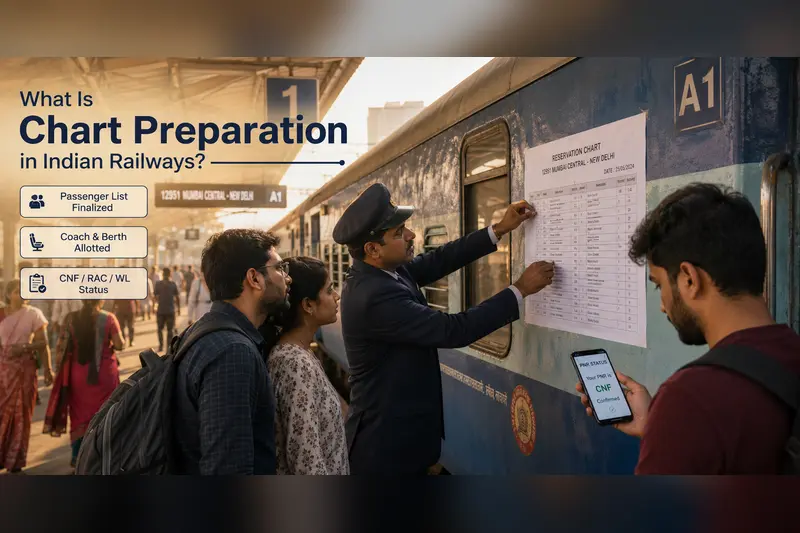
Chart preparation is the process by which Indian Railways prepares the final reservation chart for a train. This chart includes passenger details, coach numbers, seat or berth numbers, boarding stations, and final ticket status.
After chart preparation, passengers can clearly see:
- Whether the ticket is confirmed
- Whether the ticket is RAC
- Whether the ticket remains waitlisted
- Coach and berth number
- Boarding details
- Final reservation status
For passengers, chart preparation time is important because it reduces uncertainty before the journey. For Indian Railways, it helps manage seats, verify passengers, and allot vacant berths properly.
Latest Chart Preparation Time in Indian Railways
Earlier, many passengers knew the old rule that the chart was usually prepared around 4 hours before departure. That is no longer the full picture. Indian Railways has moved toward earlier chart preparation so passengers can get more time to plan their journey.
According to official railway information, advance reservation charts now happen around 9 to 18 hours before departure instead of 4 hours, helping waitlisted passengers plan alternative travel and supporting passengers from remote locations.
Here is the easier way to understand the updated timing:
| Train departure time | First chart preparation time |
|---|---|
| 5:01 AM to 2:00 PM | By 8:00 PM on the previous evening |
| After 2:00 PM and before 5:00 AM | At least 10 hours before departure |
| Final chart | Around 30 minutes before departure |
The Economic Times also reported that trains departing between 5 AM and 2 PM have the first chart prepared by 8 PM the previous evening, while trains departing after 2 PM and before 5 AM have the first chart prepared at least 10 hours before departure.
First Chart vs Final Chart: What Is the Difference?
Many passengers think only one chart is prepared, but Indian Railways can prepare more than one chart. This is why your ticket status may still change after the first chart.
First Chart
The first chart is the main reservation chart. It gives passengers early clarity about ticket status. Most confirmed seats, RAC positions, and waiting list updates are shown here.
The first chart helps you decide whether to:
- Continue with your journey
- Look for another train
- Check current booking
- Wait for the final chart
- Avoid unnecessary travel to the station
Final Chart
The final chart is usually prepared closer to departure, around 30 minutes before the train leaves. This chart includes last-minute cancellations, current booking updates, and final seat adjustments.
The final chart matters most for RAC and waiting list passengers because small changes can happen between the first chart and final chart.
Why Chart Preparation Time Matters for Passengers
Chart preparation time matters because it directly affects your travel decision. If your ticket is confirmed, you can travel normally. If it is RAC, you can still travel, but your berth may be shared unless upgraded. If your e-ticket remains fully waitlisted after chart preparation, you may not be allowed to travel in reserved coaches.
This timing is especially useful for:
- Waiting list passengers
- RAC passengers
- Tatkal ticket holders
- Families traveling with children
- Senior citizens
- Passengers boarding from intermediate stations
- People planning connecting journeys
Earlier chart preparation gives passengers more time to make smart decisions instead of rushing to the station with uncertainty.
What Happens After Chart Preparation?
After the chart is prepared, your PNR status becomes much clearer. The system updates your ticket based on seat availability, cancellations, quotas, and passenger movement.
Here is what usually happens:
| Ticket status | What it means after chart preparation |
|---|---|
| CNF | Your seat or berth is confirmed |
| RAC | You can travel, but may share a berth |
| WL e-ticket | Usually auto-cancelled if fully waitlisted |
| WL counter ticket | Different rules may apply; check with railway staff |
| TQWL | Tatkal waiting list; lower confirmation chance than GNWL |
| GNWL | General waiting list; often better confirmation chance |
| RLWL | Remote location waiting list; depends on station quota |
This is why checking your ticket after chart preparation time is very important.
Can a Waiting List Ticket Get Confirmed After Chart Preparation?
Yes, it can happen in some cases, but you should not depend on it blindly.
A waiting list ticket may move because of:
- Passenger cancellations
- RAC upgrades
- Quota release
- No-show passengers
- Seat adjustments
- Remote location charting
- Final chart changes
However, if your e-ticket remains fully waitlisted after the final chart, it is usually not valid for travel in reserved coaches. Indian Railways refund rules also state that if all passengers on a waitlisted e-ticket remain on the waiting list after chart preparation, their names are dropped from the reservation chart and the refund is credited after applicable charges.
What Happens to RAC Tickets After Chart Preparation?
RAC means Reservation Against Cancellation. If your ticket is RAC after chart preparation, you can travel.
After chart preparation time, RAC passengers may see three situations:
- RAC becomes confirmed
- RAC remains RAC
- RAC improves after final chart or onboard adjustment
If your RAC does not become confirmed, you still get permission to travel. In many cases, two RAC passengers share one side lower berth. If confirmed passengers cancel or do not board, the TTE may upgrade RAC passengers based on availability.
Can You Travel With A Waiting List Ticket After Chart Preparation?

This depends on the ticket type.
Fully Waitlisted E-Ticket
If your e-ticket remains fully waitlisted after chart preparation, it is usually auto-cancelled. You should not board reserved coaches with a fully waitlisted e-ticket.
Counter Waiting List Ticket
Counter tickets may have different handling compared with e-tickets. However, traveling in reserved coaches without confirmation can still create problems. The safest option is to check your final status and ask railway staff if you are unsure.
RAC Ticket
RAC passengers can travel. They may not get a full berth immediately, but they are allowed to board.
Current Booking After Chart Preparation
One useful point many passengers miss is the current booking. If seats remain vacant after the first chart, Indian Railways may allow current booking against vacant accommodation.
IRCTC guidelines say current booking is allowed after charting within the booking time limit specified by Railways, only e-ticket booking is allowed, and only confirmed tickets are booked under current booking.
This means if your ticket does not confirm, you should not only keep refreshing your old PNR. You can also check current booking availability for the same route or nearby trains.
Remote Location Charting Explained
Remote location charting is important for passengers who board from intermediate stations instead of the train’s origin station.
For example, suppose a train starts from Delhi but you board from Kanpur or Prayagraj. In some cases, charting and seat allocation may also depend on the remote location quota or boarding point. This is why your ticket status may behave differently from someone boarding at the origin station.
This is one area where many articles stay too basic. For a passenger, the key point is simple: if you are boarding from an intermediate station, check your PNR after the first chart and again before boarding.
Boarding Point Change After Chart Preparation
Indian Railways has also worked on passenger-friendly changes related to boarding station updates. PIB reported that passengers can change their boarding station digitally up to 30 minutes before departure from the train’s origin station, helping passengers board from the next convenient station without losing their confirmed seat.
This is useful when your plan changes at the last minute. However, always check the latest option inside IRCTC because rules may depend on ticket type, timing, and implementation status.
Chart Preparation Time Examples
Here are simple examples to understand chart preparation time better:
| Train departure | Expected first chart timing |
|---|---|
| 7:00 AM | Previous evening around 8:00 PM |
| 11:30 AM | Previous evening around 8:00 PM |
| 3:00 PM | Around 10 hours before departure |
| 8:00 PM | Around 10 hours before departure |
| 1:00 AM | Around 10 hours before departure |
| 4:30 AM | Around 10 hours before departure |
The final chart is usually prepared close to departure, around 30 minutes before the train leaves.
How to Check Chart Preparation Status
You can check whether the chart has been prepared through:
- IRCTC website
- IRCTC mobile app
- PNR status services
- Railway enquiry platforms
- SMS alerts
- Station enquiry counters
- Reservation chart display at the station
When checking your status, look for these terms:
- CNF means confirmed
- RAC means Reservation Against Cancellation
- WL means waiting list
- Chart Prepared means the reservation chart is finalized
- Chart Not Prepared means final allocation is still pending
Always check once after the first chart and again before leaving for the station, especially if your ticket is RAC or WL.
What Should You Do Based on Ticket Status?
Here is a simple passenger action guide:
| Your status | What you should do |
|---|---|
| CNF | Travel normally and note your coach/berth |
| RAC | You can board; check for an upgrade after the final chart |
| WL e-ticket | Do not board if it remains fully waitlisted after the final chart |
| WL counter ticket | Check the final rules with the railway staff before travel |
| TQWL | Keep a backup plan because confirmation can be difficult |
| GNWL | Keep checking because chances may be better than other WL types |
| RLWL | Check carefully because it depends on the remote location quota |
This section improves the article because users do not only want the meaning of chart preparation time. They want to know what action to take.
Does Chart Preparation Increase Confirmation Chances?
Chart preparation itself does not magically create seats. It only finalises the seats available after cancellations, quota release, and booking adjustments.
Your confirmation chances depend on:
- Waiting list type
- Route demand
- Train popularity
- Travel season
- Class of travel
- Day of the week
- Festival or holiday rush
- Number of cancellations
- Boarding and destination stations
For example, WL 10 on a less busy weekday route may have better chances than WL 10 on a festival-special route. That is why fixed “WL 1–20 high chance” tables are not always accurate.
Common Mistakes Passengers Make
Avoid these mistakes after chart preparation time:
- Travelling with a fully waitlisted e-ticket
- Checking PNR only once and ignoring the final chart
- Assuming RAC always becomes confirmed
- Not checking current booking availability
- Reaching the station without checking the final status
- Ignoring the boarding point rules
- Confusing the first chart with the final chart
- Booking late during festival seasons without backup
A smart passenger checks the chart, understands the status, and keeps an alternative plan ready.
Quick Passenger Checklist Before Boarding
Before leaving for the station, check this list:
- Check your PNR status after first chart
- Check again near final chart time
- Confirm coach and berth number
- Save your ticket and ID proof
- Check train running status
- Check platform information
- Confirm boarding station
- For RAC, ask the TTE politely after boarding
- For WL e-ticket, do not travel if it remains fully waitlisted
- Check current booking if your ticket is not confirmed
This small checklist can save you from confusion and unnecessary stress.
Final Thoughts
Chart preparation time is one of the most important parts of Indian Railways ticket booking. It tells you when your reservation status becomes clear and whether you can travel with confidence.
The updated system gives passengers earlier clarity than the old 4-hour process. Morning and daytime trains may have the first chart prepared the previous evening, while other trains may have the first chart prepared around 10 hours before departure. The final chart is usually prepared close to departure.
The best approach is simple: check your PNR after the first chart, recheck before boarding, understand your ticket status, and keep a backup option if your ticket is still on the waiting list.
FAQs About Chart Preparation Time
What is the chart preparation time?
Chart preparation time is the time when Indian Railways finalises the reservation chart for a train. It confirms passenger status, coach number, berth number, and final seat allocation.
When is the first chart prepared?
For trains departing between 5:01 AM and 2:00 PM, the first chart is generally prepared by 8:00 PM on the previous evening. For trains departing after 2:00 PM and before 5:00 AM, it is generally prepared at least 10 hours before departure.
When is the final chart prepared?
The final chart is usually prepared around 30 minutes before train departure. It may include last-minute changes, current booking updates, and final seat adjustments.
Can WL become confirmed after chart preparation?
Yes, it can happen in some cases, especially before the final chart. But if a fully waitlisted e-ticket remains unconfirmed after final chart preparation, it is usually not valid for travel in reserved coaches.
Can RAC passengers travel after chart preparation?
Yes. RAC passengers are allowed to travel. They may get a shared berth or may be upgraded to a full berth if seats become available.
What happens if my e-ticket remains waitlisted?
If all passengers on an e-ticket remain waitlisted after chart preparation, the names are dropped from the reservation chart, and the refund is processed after applicable charges.
Can I book a ticket after chart preparation?
Yes, the current booking may be available after chart preparation if seats are vacant. IRCTC allows current booking after charting within the railway booking time limit.
How can I check if the chart is prepared?
You can check through IRCTC, railway enquiry platforms, PNR status tools, SMS alerts, or station chart displays.
Is the chart preparation time the same for all trains?
Not always. The timing can depend on departure time, route, operational needs, and railway implementation. Morning trains often follow the previous evening’s chart rule.
Why is chart preparation important?
It helps passengers know whether their ticket is confirmed, RAC, or waitlisted. It also helps Indian Railways manage seats, cancellations, passenger records, and onboard verification.
YOU MAY ALSO LIKE:
Which of These Statements Was Implied by the Decision in Brown v. Board of Education?
Good Excuses to Miss Work on Short Notice – Valid Reasons and What to Say
What About You Meaning in Hindi – Simple Meaning, Reply and Examples


