The MSc full form is Master of Science. It is a postgraduate degree for students who want advanced knowledge in science, technology, research, mathematics, data, healthcare, environment, or related fields.
An MSc degree is usually completed after a bachelor’s degree, such as a BSc, BTech, BE, BCA, or another relevant undergraduate course. The course helps students build deeper subject knowledge, research skills, practical understanding, and better career opportunities.
In simple words, if you want to specialize in a scientific or technical subject after graduation, an MSc can be a strong next step.
MSc Full Form: Quick Comparison
| Short Form | Full Form | Used In | Simple Meaning |
|---|---|---|---|
| MSc | Master of Science | Education | A postgraduate degree in science, technology, research, and related fields. |
| M.Sc. | Master of Science | Academics | Another common way to write MSc in university courses and admission forms. |
| MSC | Mediterranean Shipping Company | Shipping | A global shipping and logistics company. This meaning depends on business context. |
| MSC | Marine Stewardship Council | Environment | An organization related to sustainable fishing and seafood certification. |
| MSC | Mobile Switching Centre | Telecom | A telecom system that helps manage mobile calls and network switching. |
Table of Contents
What is the MSc Full Form?
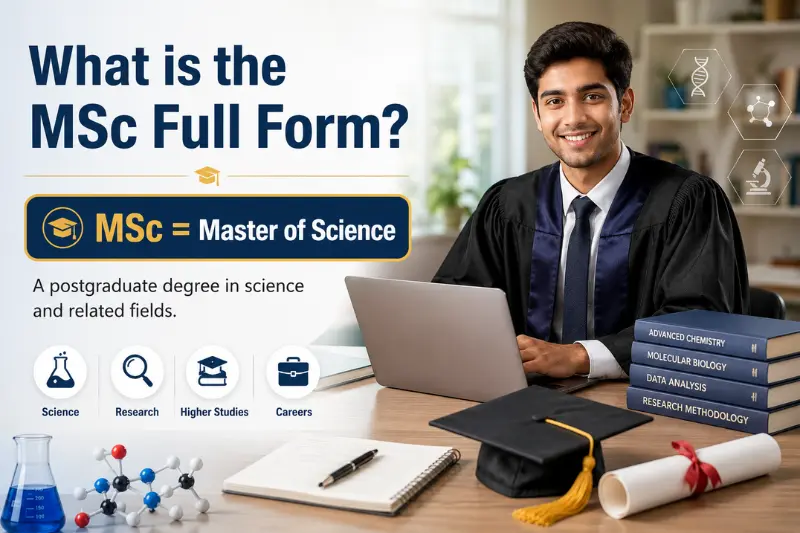
The MSc full form is Master of Science.
It is also written as:
- MSc
- M.Sc.
- Master of Science
All these terms generally mean the same thing. The degree is focused on advanced study in science-related subjects such as Physics, Chemistry, Mathematics, Computer Science, Biology, Biotechnology, Data Science, Environmental Science, and many more.
The MSc full form is important for students because many admission forms, university websites, job posts, and course lists use the short term “MSc” instead of writing the full degree name.
What is an MSc Course?
An MSc course is a postgraduate-level academic program that gives students advanced knowledge in a specific subject. Unlike a general bachelor’s degree, an MSc focuses more deeply on one field.
For example:
- MSc Computer Science focuses on programming, algorithms, AI, data, and software systems.
- MSc Chemistry focuses on organic, inorganic, physical, and analytical chemistry.
- MSc Mathematics focuses on pure mathematics, applied mathematics, statistics, and research.
- MSc Biotechnology focuses on genetics, molecular biology, bioinformatics, and lab-based research.
The MSc full form may be Master of Science, but the course is not limited to traditional science only. Today, many modern MSc programs are available in fields like Data Science, Artificial Intelligence, Cybersecurity, Psychology, Clinical Research, Food Technology, and Environmental Management.
MSc Course Highlights
| Particular | Details |
|---|---|
| MSc full form | Master of Science |
| Course level | Postgraduate |
| Course duration | Usually 2 years |
| Eligibility | Bachelor’s degree in a relevant subject |
| Minimum marks | Commonly 50% to 60%, depending on university |
| Admission type | Merit-based or entrance exam-based |
| Popular exams | IIT JAM, CUET PG, university-level entrance exams |
| Course mode | Regular, distance, online, or part-time |
| Average fees | Varies by college, course, and country |
| Career options | Researcher, teacher, data analyst, scientist, developer, consultant |
| Higher studies | PhD, MPhil, MBA, professional certifications |
Why is an MSc Degree Important?
An MSc degree is useful for students who want more than basic subject knowledge. It helps you move from general learning to specialised expertise.
An MSc can help you:
- Build advanced subject knowledge
- Improve research and analytical skills
- Qualify for higher-level jobs
- Prepare for PhD or academic careers
- Enter technical and scientific industries
- Increase your earning potential
- Build confidence in practical and theoretical work
The MSc full form is Master of Science, but the real value of the degree depends on your specialization, college, practical skills, and career goals.
MSc Course Duration
The usual duration of an MSc course is 2 years. Most universities divide it into 4 semesters.
However, the duration can change depending on the study mode:
- Regular MSc: Usually 2 years
- Part-time MSc: Usually 2 to 4 years
- Distance MSc: Usually 2 years, but flexible in some universities
- Online MSc: Depends on the university and program structure
- Integrated MSc: Usually 5 years after class 12
Students should always check the exact duration on the official university or college website before applying.
MSc Eligibility Criteria
The eligibility for an MSc course depends on the university, country, and specialisation. However, most institutions follow some common requirements.
Basic eligibility usually includes:
- A bachelor’s degree from a recognised university
- A relevant subject background
- Minimum marks, usually around 50% to 60%
- Entrance exam score, if required
- No strict age limit in most institutions
For example, if you want to apply for an MSc in Physics, universities may prefer a bachelor’s degree with Physics. If you want to pursue an MSc in Computer Science, you may be required to have a background in Computer Science, IT, Mathematics, or a related field.
Can You Do MSc After BSc, BTech, BA, or BCA?

This is one area where many students get confused. The MSc full form is Master of Science, but that does not always mean only BSc students can apply.
MSc After BSc
Yes, BSc students are the most common applicants for MSc programs. If you have completed a BSc in Physics, Chemistry, Biology, Mathematics, Computer Science, or a related subject, you can apply for a relevant MSc specialisation.
MSc after B.Tech or BE
Yes, many universities allow BTech or BE students to apply for MSc courses, especially in technical fields such as Computer Science, Data Science, Mathematics, Artificial Intelligence, Physics, and Environmental Science.
MSc After BCA
Yes, BCA graduates may apply for MSc Computer Science, MSc IT, MSc Data Science, or similar programs, depending on the university’s rules.
MSc After BA
In some cases, BA graduates can apply for selected MSc programs, but it depends on the subject. For example, MSc Psychology, MSc Economics, or MSc Statistics may accept students from related academic backgrounds. However, science-heavy courses may require a science background.
MSc Admission Process
The MSc admission process can be different from one university to another, but the general steps are usually simple.
Common Admission Steps
- Choose your MSc specialisation.
- Check the eligibility criteria.
- Shortlist colleges or universities.
- Fill out the application form.
- Upload required documents.
- Appear for the entrance exam, if needed.
- Wait for the merit list or result.
- Attend counselling or an interview, if required.
- Pay the admission fee.
- Confirm your seat.
Some universities offer direct admission based on graduation marks, while others require entrance exams.
Popular MSc Entrance Exams
Many universities conduct entrance exams for MSc admission. Some common entrance exams include:
- IIT JAM
- CUET PG
- University-level entrance exams
- State-level postgraduate entrance exams
- Institute-specific admission tests
For international MSc programs, students may need exams like GRE, IELTS, TOEFL, or other language and academic tests, depending on the country and university.
Students should always check official exam websites for updated dates, syllabus, fees, and application deadlines.
Popular MSc Specialisations
One reason students search for the MSc full form is that they want to understand which course is right for them. MSc offers many specialisation options.
Popular MSc specialisations include:
- MSc Physics
- MSc Chemistry
- MSc Mathematics
- MSc Biology
- MSc Botany
- MSc Zoology
- MSc Computer Science
- MSc Information Technology
- MSc Data Science
- MSc Artificial Intelligence
- MSc Biotechnology
- MSc Microbiology
- MSc Environmental Science
- MSc Psychology
- MSc Statistics
- MSc Food Technology
- MSc Clinical Research
- MSc Forensic Science
- MSc Agriculture
- MSc Economics
- MSc Geology
Your choice should depend on your interests, academic background, job goals, and future study plans.
How to Choose the Right MSc Specialization
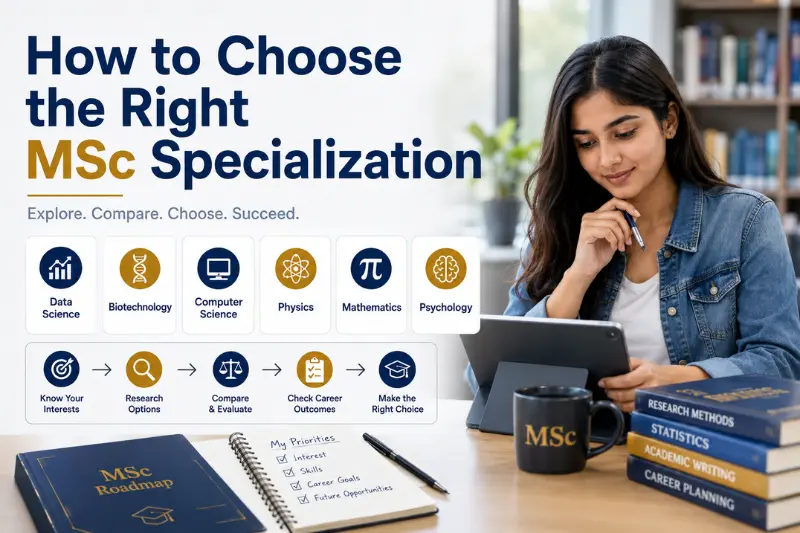
Choosing the right MSc specialization is more important than simply choosing a popular course. A good specialization should match your strengths and career plans.
Before choosing, ask yourself:
- Which subject do I enjoy studying?
- Do I want a job after MSc or a PhD?
- Do I prefer lab work, research, coding, teaching, or fieldwork?
- Which industries are growing in my chosen field?
- Does the college offer practical training or projects?
- Are internships or research opportunities available?
- What are the salary and job options after this specialization?
For example, if you enjoy coding and problem-solving, MSc Computer Science or MSc Data Science may suit you. If you like research and lab work, MSc Biotechnology, Chemistry, or Microbiology may be a better fit.
MSc Syllabus
The MSc syllabus depends on the specialization. However, most MSc programs include theory, practical work, projects, seminars, and research-based assignments.
Common Subjects in MSc
Depending on the specialization, students may study:
- Advanced subject theory
- Research methodology
- Laboratory work
- Data analysis
- Practical experiments
- Technical writing
- Project work
- Dissertation or thesis
- Seminars and presentations
Example: MSc Computer Science Syllabus
- Data Structures
- Algorithms
- Database Management Systems
- Artificial Intelligence
- Machine Learning
- Computer Networks
- Operating Systems
- Software Engineering
- Cloud Computing
- Research Project
Example: MSc Chemistry Syllabus
- Organic Chemistry
- Inorganic Chemistry
- Physical Chemistry
- Analytical Chemistry
- Spectroscopy
- Environmental Chemistry
- Medicinal Chemistry
- Laboratory Work
- Research Project
Example: MSc Mathematics Syllabus
- Real Analysis
- Linear Algebra
- Abstract Algebra
- Differential Equations
- Complex Analysis
- Probability
- Statistics
- Numerical Methods
- Research Work
The MSc full form may be the same for all students, but the syllabus changes completely based on the chosen subject.
MSc Course Fees
MSc course fees depend on the college, university, location, course type, and specialization.
In general:
- Government colleges are usually more affordable.
- Private universities usually charge higher fees.
- Technical and professional MSc courses may cost more.
- Online or distance MSc programs may be cheaper than regular programs.
- Lab-based courses may include additional practical or lab charges.
Students should compare tuition fees, hostel fees, exam fees, lab fees, and other costs before applying.
Career Opportunities After MSc
An MSc degree can open many career paths. The right job depends on your specialization and skills.
Common career options after MSc include:
- Research Scientist
- Data Analyst
- Data Scientist
- Software Developer
- Lab Technician
- Lecturer
- Assistant Professor
- Environmental Consultant
- Biotechnologist
- Microbiologist
- Chemist
- Statistician
- Quality Analyst
- Clinical Research Associate
- Scientific Writer
- Project Assistant
- Research Associate
Many students also choose higher studies after MSc, especially if they want to work in teaching, research, or academic fields.
Career Options by MSc Specialization
| MSc Specialization | Career Options |
|---|---|
| MSc Computer Science | Software Developer, Data Analyst, AI Engineer, IT Consultant |
| MSc Data Science | Data Scientist, Business Analyst, Machine Learning Engineer |
| MSc Physics | Research Scientist, Lecturer, Lab Specialist, Data Analyst |
| MSc Chemistry | Chemist, Quality Analyst, Pharmaceutical Researcher |
| MSc Mathematics | Statistician, Actuary, Data Analyst, Teacher |
| MSc Biotechnology | Biotechnologist, Clinical Researcher, Lab Scientist |
| MSc Microbiology | Microbiologist, Research Assistant, Quality Control Officer |
| MSc Environmental Science | Environmental Consultant, Sustainability Analyst |
| MSc Psychology | Counsellor, Research Assistant, HR Specialist |
| MSc Statistics | Statistician, Risk Analyst, Data Analyst |
MSc Salary Scope
Salary after MSc depends on several factors, such as specialization, skills, location, industry, company, and experience.
Students with strong practical skills, internships, research projects, coding knowledge, lab experience, or data skills often get better opportunities.
High-demand fields such as Data Science, Artificial Intelligence, Computer Science, Biotechnology, Statistics, and Clinical Research may offer stronger salary growth.
However, students should not choose an MSc only for salary. Interest, skill development, and long-term career goals matter more.
Top Recruiters for MSc Graduates
MSc graduates can work in different sectors depending on their specialization.
Common hiring sectors include:
- IT companies
- Research organizations
- Pharmaceutical companies
- Biotechnology firms
- Universities and colleges
- Hospitals and laboratories
- Environmental agencies
- Government departments
- Finance and analytics companies
- Food and agriculture industries
- Scientific publishing and content companies
Some students also work as freelancers, online tutors, research writers, data analysts, or consultants after building strong practical skills.
MSc vs MS vs MBA
Many students search for the MSc full form because they also want to compare it with other postgraduate degrees.
| Course | Best For | Focus |
|---|---|---|
| MSc | Science, research, technical, and academic careers | Subject specialization |
| MS | Research and international technical careers | Advanced science or engineering study |
| MBA | Business, management, leadership, and entrepreneurship | Management and business skills |
Which One Should You Choose?
Choose MSc if you want deep knowledge in science, technology, research, or academics.
Choose MS if you are planning for international study or advanced technical research.
Choose MBA if you want to move toward business, management, marketing, finance, HR, or leadership roles.
Benefits of Pursuing an MSc
An MSc degree has many benefits for students who want to grow academically and professionally.
Key benefits include:
- Better subject expertise
- Stronger research skills
- More career options
- Better preparation for PhD
- Higher academic qualification
- Improved technical knowledge
- Better chances in teaching and research
- Opportunity to work in specialized industries
The MSc full form is Master of Science, but for many students, it also means a step toward a more focused and stable career.
Skills You Can Build During MSc
A good MSc program does not only teach theory. It also helps students build practical and professional skills.
Important skills include:
- Research skills
- Problem-solving
- Critical thinking
- Data analysis
- Technical writing
- Presentation skills
- Lab handling
- Programming skills
- Project management
- Teamwork
- Communication skills
These skills are useful in jobs, higher studies, research, and business.
Common Mistakes Students Should Avoid
Many students choose an MSc without proper planning. This can create confusion later.
Avoid these mistakes:
- Choosing a specialization only because it is popular
- Ignoring the university’s reputation
- Not checking the syllabus
- Not comparing fees and career outcomes
- Ignoring practical training
- Not building extra skills during the course
- Waiting until the final semester to think about jobs
- Not preparing for entrance exams early
- Choosing a course without understanding its career scope
A smart student should research properly before applying.
Is MSc Good for the Future?
Yes, an MSc can be a good choice if it matches your interests and career plans. Science, technology, data, healthcare, environment, and research-based careers continue to need skilled professionals.
MSc can be especially useful if you want to:
- Become a researcher
- Work in technical industries
- Teach in colleges
- Apply for a PhD
- Build a career in data or AI
- Work in labs or research centres
- Enter scientific writing or consulting
- Improve your subject knowledge
However, the degree alone is not enough. You should also build practical skills, complete projects, gain internships, and stay updated with industry trends.
Conclusion
The MSc full form is Master of Science, and it is one of the most valuable postgraduate degrees for students interested in science, research, technology, data, healthcare, environment, and academic careers.
An MSc course helps students gain advanced knowledge, practical skills, and a better career direction. It can lead to jobs in research, teaching, IT, biotechnology, pharmaceuticals, analytics, laboratories, and many other sectors.
Before choosing an MSc program, students should check the eligibility, syllabus, fees, specialization, college reputation, entrance exam requirements, and career scope. The right MSc specialization can help you build a stronger future and move closer to your academic or professional goals.
FAQs About MSc Full Form
What is the MSc full form?
The MSc full form is Master of Science. It is a postgraduate degree in science, technology, research, and related fields.
Is MSc a postgraduate degree?
Yes, MSc is a postgraduate degree. Students usually apply for it after completing a bachelor’s degree.
What is the duration of MSc?
The duration of MSc is usually 2 years. Some part-time, online, or integrated programs may have a different duration.
Who can apply for MSc?
Students with a bachelor’s degree in a relevant subject can apply for MSc. Eligibility depends on the university and specialization.
Can I do MSc after BTech?
Yes, many universities allow BTech or BE graduates to apply for relevant MSc courses.
Can I do MSc after BCA?
Yes, BCA graduates can apply for MSc Computer Science, MSc IT, MSc Data Science, or related programs if they meet the eligibility criteria.
Is an entrance exam required for MSc?
Some universities require entrance exams, while others offer merit-based admission.
What are the popular MSc specializations?
Popular MSc specializations include Computer Science, Physics, Chemistry, Mathematics, Biology, Biotechnology, Data Science, Environmental Science, and Psychology.
What is the difference between MSc and MBA?
MSc focuses on science, research, and technical specialization. MBA focuses on business, management, and leadership.
Can I get a job after MSc?
Yes, MSc graduates can work in research, teaching, IT, healthcare, biotechnology, data, environment, and many other fields.
Is MSc better than BSc?
MSc is a higher qualification than BSc. It gives advanced knowledge and can improve career and research opportunities.
Can I do PhD after MSc?
Yes, MSc is one of the common qualifications required for PhD admission in many subjects.
YOU MAY ALSO LIKE:
Happy Eve Meaning – What It Really Means and How to Use It
FYKI Full Form – Meaning, Usage, Examples, And When To Use It
IFSC Full Form: Meaning, Format, Uses and Examples
APBCR Full Form – Meaning in Banking, Uses, and Simple Explanation
FCI HRMS: Login, Payslip, Leave, ERS Portal, App & Employee Services