


Last Updated: June 2026 | Covers: History, Science, Geography, Sports, Technology, Current Affairs, World GK, India GK
This is a complete, free collection of GK questions with answers built specifically for students preparing for UPSC, SSC CGL, RRB NTPC, IBPS, NDA, and state-level exams in 2026. Every answer includes an explanation, not just the correct option, because understanding why an answer is correct is what separates top scorers from average ones.
One thing this guide does differently: it flags the commonly confused versions of questions, marks answers that examiners love to twist, and separates questions by difficulty so you can track your actual progress. Nothing here is padded. If a section is included, it is because it has appeared in actual competitive Exams or is part of the 2026 syllabus updates.
Table of Contents
10 GK Facts That Actually Appear in Exams But Get Skipped in Most Lists
Before getting into category-wise questions, here are ten facts that examiners at UPSC, SSC, and Railway boards have used repeatedly in tricky formats:
- India’s first woman IPS officer was Kiran Bedi (1972), but India’s first woman IAS officer was Anna Rajam Malhotra (1951). These are two separate records that thousands of students confuse every year.
- The Indian Constitution originally had 395 articles when adopted in 1950. It now has 448 articles after amendments. Both numbers appear in exam options to confuse you.
- Mount Everest is the highest peak above sea level. Mauna Kea in Hawaii is the tallest mountain when measured from its underwater base. The question wording tells you which answer is correct.
- The Tropic of Cancer passes through exactly 8 Indian states: Gujarat, Rajasthan, Madhya Pradesh, Chhattisgarh, Jharkhand, West Bengal, Tripura, and Mizoram.
- Article 21 of the Indian Constitution protects the right to life and personal liberty. Courts have expanded its scope to include the right to education, health, livelihood, and a clean environment through landmark judgements.
- The ozone layer sits in the stratosphere, approximately 15 to 35 km above Earth’s surface. A very common exam trap is listing the thermosphere as the answer.
- Google’s quantum processor called Willow, launched in 2024, solved a benchmark computation in under 5 minutes that would take classical supercomputers longer than the current age of the universe to complete.
- India became the first country to land near the lunar south pole when Chandrayaan-3’s Vikram lander touched down on August 23, 2023.
- The International Solar Alliance, India’s initiative, had over 100 member countries by 2026, making it the largest clean energy alliance in the world.
- The term Artificial Intelligence was coined by John McCarthy in 1956 at the Dartmouth Conference. Alan Turing had earlier proposed the concept of a thinking machine, but the term AI itself is McCarthy’s contribution. These are two separate milestones.
GK Questions on Indian History
Easy Level
Q1. Who was the first President of India? Answer: Dr Rajendra Prasad. He served as India’s first President from 1950 to 1962, which remains the longest term anyone has held the office.
Q2. In which year did India gain independence? Answer: 1947 (August 15) India became independent from British rule on August 15, 1947.
Q3. Who is known as the Father of the Indian Nation? Answer: Mahatma Gandhi Mohandas Karamchand Gandhi led India’s non-violent freedom struggle over several decades and is recognised as the Father of the Nation.
Q4. Who wrote the Indian National Anthem? Answer: Rabindranath Tagore Jana Gana Mana was written by Tagore and officially adopted as the national anthem on January 24, 1950.
Q5. Who founded the Arya Samaj in 1875? Answer: Swami Dayananda Saraswati Arya Samaj was a reformist Hindu movement that rejected idol worship and promoted Vedic education. It played a significant role in social reform during British India.
Medium Level
Q6. Who was the last Viceroy of British India? Answer: Lord Louis Mountbatten He oversaw the transfer of power and the partition of India in 1947.
Q7. The Battle of Plassey (1757) was fought between whom? Answer: The British East India Company, led by Robert Clive and the Nawab of Bengal, Siraj-ud-Daulah. The British victory at Plassey marked the beginning of colonial rule in Bengal and is considered a turning point in Indian history.
Q8. Which Act introduced dyarchy in Indian provinces? Answer: Government of India Act, 1919, also known as the Montagu-Chelmsford Reforms. Dyarchy divided provincial subjects into two categories: transferred subjects controlled by Indian ministers, and reserved subjects retained by British governors.
Q9. Who founded the Indian National Congress in 1885? Answer: A.O. Hume (Allan Octavian Hume), a British civil servant, founded the INC to provide a platform for educated Indians to engage with British administration.
Q10. The Dandi March of 1930 was a protest against which British law? Answer: The Salt Act (Salt Tax). Gandhi led a 388 km march from Sabarmati Ashram to Dandi, Gujarat, to protest the British monopoly on salt production and sale.
Hard Level
Q11. Was the Partition of Bengal in 1905 recommended by any committee? Answer: No. It was a unilateral administrative decision by Viceroy Lord Curzon. This is a frequent trap in objective exams. Many options list fictitious committee names. There was no committee. Lord Curzon ordered it directly.
Q12. What was the August Offer of 1940? Answer: An offer by British Viceroy Lord Linlithgow promising Dominion Status to India after World War II in exchange for cooperation during the war. The Indian National Congress rejected it because it did not commit to full independence and denied Indians control over the war effort.
Q13. The Poona Pact of 1932 was signed between whom and for what purpose? Answer: Between B.R. Ambedkar and Mahatma Gandhi, regarding reserved seats for Depressed Classes in provincial legislatures. It replaced the Communal Award’s separate electorates with joint electorates while increasing the total number of reserved seats for the Scheduled Castes.
YOU MAY ALSO LIKE:
What Is the Role of Education in Human Capital Formation?
Never Confuse Present Perfect Continuous Tense Examples Again
GK Questions on World History
Q14. Which event triggered World War I? Answer: The assassination of Archduke Franz Ferdinand of Austria-Hungary on June 28, 1914, in Sarajevo. Gavrilo Princip, a Bosnian Serb nationalist, carried out the assassination. It triggered a chain of alliances that pulled most of Europe into war within weeks.
Q15. When did the Berlin Wall fall? Answer: November 9, 1989. Its fall symbolised the end of the Cold War and led to the reunification of Germany in October 1990.
Q16. What does the United Nations Security Council consist of? Answer: 5 permanent members (USA, UK, France, Russia, China) and 10 non-permanent members elected for 2-year terms. Permanent members hold veto power, making any one of them capable of blocking a Security Council resolution.
Q17. Who is credited with completing the first circumnavigation of the globe? Answer: The expedition was led by Ferdinand Magellan but completed by Juan Sebastián Elcano after Magellan died in the Philippines in 1521. The voyage ran from 1519 to 1522. Magellan is credited with initiating it, but did not survive to finish it.
GK Questions on Indian Geography
Q18. Which is the longest river that flows entirely within India? Answer: The Ganga (approximately 2,525 km). The Indus is longer in total length, but most of its course runs through Pakistan. The Ganga is the longest river flowing entirely within Indian territory.
Q19. Which state has the longest coastline in India? Answer: Gujarat (approximately 1,600 km). Gujarat’s coastline is the longest among all Indian states, followed by Andhra Pradesh.
Q20. Where is the Siachen Glacier located? Answer: In the Karakoram Range, in the union territory of Ladakh. At about 76 km in length, it is the world’s second-longest non-polar glacier and the site of the world’s highest battlefield.
Q21. The Tropic of Cancer passes through how many Indian states? Answer: 8 states: Gujarat, Rajasthan, Madhya Pradesh, Chhattisgarh, Jharkhand, West Bengal, Tripura, and Mizoram. Memory tip: Gar Raja Madhav Chhath Jhare, Pashchim Tripura Mile (Gujarat, Rajasthan, Madhya Pradesh, Chhattisgarh, Jharkhand, West Bengal, Tripura, Mizoram).
Q22. Which river is known as the “Sorrow of Bihar”? Answer: River Kosi. Kosi is notorious for its frequent flooding and shifting course, causing widespread destruction across Bihar almost every monsoon season.
Q23. What is the southernmost tip of India? Answer: Indira Point, also called Pygmalion Point, located in the Nicobar Islands. Many students confuse this with Kanyakumari, which is only the southernmost tip of mainland India. Indira Point extends further south.
GK Questions on World Geography
Q24. Which is the largest country in the world by area? Answer: Russia (approximately 17.1 million sq km).
Q25. Which is the smallest country in the world? Answer: Vatican City (0.44 sq km).
Q26. What is the deepest lake in the world? Answer: Lake Baikal in Russia (1,642 m deep). It also holds about 20% of the world’s unfrozen surface freshwater, making it the largest freshwater lake by volume.
Q27. Which desert is the largest in the world? Answer: The Antarctic Desert (14.2 million sq km). The Sahara is the largest hot desert. Antarctica qualifies as a cold desert and is larger overall. This distinction appears frequently in objective exams.
Q28. Where is the Great Barrier Reef located? Answer: Off the northeast coast of Queensland, Australia.
Q29. Which country has the most natural lakes in the world? Answer: Canada. Canada contains over 60% of the world’s lakes, a fact that rarely appears in standard GK guides but has been asked in competitive exams.
GK Questions on Science
Physics
Q30. What is the SI unit of force? Answer: Newton (N).
Q31. What does E = mc² represent? Answer: Energy equals mass multiplied by the speed of light squared. It shows that mass and energy are interchangeable. This equation by Albert Einstein is the theoretical foundation of nuclear energy.
Q32. What is the speed of light in a vacuum? Answer: Approximately 3 × 10⁸ metres per second (299,792,458 m/s).
Q33. What is the principle behind a periscope? Answer: Reflection of light using two parallel mirrors set at 45-degree angles.
Chemistry
Q34. What is the chemical formula of water? Answer: H₂O (two hydrogen atoms bonded to one oxygen atom).
Q35. Which gas is most abundant in Earth’s atmosphere? Answer: Nitrogen (approximately 78%). Oxygen is second at about 21%. Argon follows at about 0.9%. Many students incorrectly answer oxygen.
Q36. What is the hardest natural substance on Earth? Answer: Diamond (carbon in its crystalline form).
Q37. What is the pH of pure water? Answer: 7 (neutral). Values below 7 are acidic; above 7 are alkaline or basic.
Q38. Which element has the highest melting point? Answer: Tungsten (W) at 3,422°C. This is why tungsten is used in incandescent light bulb filaments.
Biology
Q39. What is the powerhouse of the cell? Answer: Mitochondria. They produce ATP (adenosine triphosphate) through the process of cellular respiration, providing energy to the cell.
Q40. What is the largest organ of the human body? Answer: The skin. The liver is the largest internal organ. The skin is the largest organ of the body overall. Both versions of this question appear in exams.
Q41. How many chromosomes does a normal human cell have? Answer: 46 (23 pairs).
Q42. Which blood group is the universal donor? Answer: O negative (O-).
Q43. Which blood group is the universal recipient? Answer: AB positive (AB+).
Q44. What is the function of red blood cells? Answer: To carry oxygen from the lungs to the rest of the body and return carbon dioxide to the lungs via haemoglobin.
GK Questions on Technology and AI (2026 Updated)
Q45. Who coined the term Artificial Intelligence? Answer: John McCarthy, in 1956 at the Dartmouth Conference. Note: Alan Turing proposed the concept of a thinking machine earlier, but the actual term Artificial Intelligence belongs to McCarthy. Examiners use both names in options.
Q46. What is quantum computing? Answer: A type of computing that uses quantum bits (qubits), which can exist in multiple states simultaneously, to solve complex problems far faster than classical computers.
Q47. What is Google’s quantum processor launched in 2024 called? Answer: Willow. Google’s Willow processor solved a benchmark computation in under 5 minutes that would take today’s fastest classical supercomputers longer than the age of the universe.
Q48. What does 5G stand for, and what does it offer over 4G? Answer: Fifth-generation wireless technology. It offers speeds up to 100 times faster than 4G, ultra-low latency, and the capacity to connect billions of devices simultaneously.
Q49. What is the full form of URL? Answer: Uniform Resource Locator. It is the web address used to identify and locate a specific resource on the internet.
Q50. Which Indian company partnered with NVIDIA to build India’s first gigawatt-scale AI factory in 2026? Answer: Larsen and Toubro (L&T). This marks a major milestone in India’s AI infrastructure development and is expected to be a recurring current affairs question through 2026.
Q51. What is NavIC? Answer: Navigation with Indian Constellation, India’s indigenous satellite navigation system formerly known as IRNSS (Indian Regional Navigation Satellite System). In 2025-26, India began mandating NavIC chip integration in smartphones sold domestically, giving this topic renewed exam relevance.
Q52. What AI model did Google launch at Google I/O 2026? Answer: Gemini 2.5 Pro, with significant updates focused on agentic capabilities and advanced coding applications.
Q53. What does GPS stand for? Answer: Global Positioning System. Developed by the US Department of Defense, it uses a network of satellites to provide precise location data.
GK Questions on Indian Polity and Constitution
Q54. When was the Indian Constitution adopted, and when did it come into effect? Answer: Adopted on November 26, 1949. Came into effect on January 26, 1950. November 26 is observed as Constitution Day (Samvidhan Divas). January 26 is Republic Day.
Q55. Who chairs the Rajya Sabha? Answer: The Vice President of India serves as the ex officio Chairman of the Rajya Sabha.
Q56. Which article of the Indian Constitution deals with the Right to Equality? Answer: Articles 14 to 18.
Q57. Under which article can the President declare a National Emergency? Answer: Article 352.
Q58. How many Fundamental Rights does the Indian Constitution guarantee? Answer: Six Fundamental Rights. Right to Equality, Right to Freedom, Right against Exploitation, Right to Freedom of Religion, Cultural and Educational Rights, and Right to Constitutional Remedies. The original seven rights included the Right to Property, which was removed by the 44th Amendment in 1978 and converted into a legal right under Article 300A.
Q59. What does the Preamble of the Indian Constitution declare India to be? Answer: A Sovereign, Socialist, Secular, Democratic Republic that secures Justice, Liberty, Equality, and Fraternity for its citizens. The words Socialist and Secular were added by the 42nd Constitutional Amendment in 1976.
Q60. Which is the highest court in India? Answer: The Supreme Court of India was established on January 26, 1950.
Q61. Which schedule of the Constitution deals with anti-defection? Answer: The Tenth Schedule, added by the 52nd Constitutional Amendment in 1985.
Q62. Which Article allows the President to seek the Supreme Court’s advisory opinion? Answer: Article 143.
GK Questions on the Indian Economy
Q63. What is India’s rank by GDP (nominal) as of 2025-26? Answer: 5th largest economy in the world, behind the USA, China, Germany, and Japan.
Q64. What does GST stand for? Answer: Goods and Services Tax. It was implemented in India on July 1, 2017, replacing multiple indirect taxes, including Central Excise Duty, Service Tax, and VAT.
Q65. Which body regulates the monetary policy of India? Answer: The Reserve Bank of India (RBI).
Q66. What is the repo rate? Answer: The rate at which the RBI lends short-term money to commercial banks. A lower repo rate makes borrowing cheaper and is used to stimulate economic growth.
Q67. What is the fiscal deficit? Answer: The difference between the government’s total expenditure and its total revenue excluding borrowings. It indicates how much the government needs to borrow to meet its expenses.
Q68. What does MSME stand for? Answer: Micro, Small and Medium Enterprises. They contribute approximately 30% of India’s GDP and account for nearly 45% of India’s total exports.
GK Questions on Sports
Q69. Who won the ICC Men’s Cricket World Cup 2023? Answer: Australia, which defeated India in the final held in Ahmedabad.
Q70. Which country has won the most FIFA World Cup titles? Answer: Brazil with 5 titles (1958, 1962, 1970, 1994, 2002).
Q71. Who holds the record for the most Olympic gold medals? Answer: Michael Phelps (USA) with 23 Olympic gold medals in swimming.
Q72. In which sport is the Durand Cup awarded? Answer: Football (Soccer). The Durand Cup is Asia’s oldest and India’s oldest football tournament, established in 1888.
Q73. Who is known as the “Flying Sikh” of India? Answer: Milkha Singh, the legendary Indian sprinter.
Q74. Who won the first individual Olympic gold medal for India? Answer: Abhinav Bindra, in the 10m Air Rifle event at the 2008 Beijing Olympics.
Q75. What is the highest individual score in a Test cricket innings? Answer: 400 not out by Brian Lara (West Indies) against England in 2004.
GK Questions on Awards and Honours
Q76. What is India’s highest civilian honour? Answer: Bharat Ratna.
Q77. What is India’s highest gallantry award? Answer: Param Vir Chakra, awarded for the highest acts of valour in the face of the enemy.
Q78. Who received the Bharat Ratna in 2024? Answer: Five individuals were awarded Bharat Ratna in 2024: Lal Krishna Advani, Chaudhary Charan Singh, P.V. Narasimha Rao, M.S. Swaminathan (posthumous), and Karpoori Thakur (posthumous).
Q79. Who won the Nobel Prize in Literature in 2023? Answer: Jon Fosse of Norway.
Q80. What is the full form of BAFTA? Answer: British Academy of Film and Television Arts.
GK Questions on Environment and Ecology
Q81. What is the greenhouse effect? Answer: The process by which greenhouse gases such as CO₂, CH₄, N₂O, and water vapour trap heat from the sun within Earth’s atmosphere. An intensified greenhouse effect leads to global warming and climate change.
Q82. Which gas is primarily responsible for ozone layer depletion? Answer: Chlorofluorocarbons (CFCs), released from old refrigerants and aerosol sprays.
Q83. What is biodiversity? Answer: The variety of all living organisms on Earth, including plants, animals, fungi, and microorganisms and the ecosystems they form together.
Q84. What is the Paris Agreement? Answer: A 2015 international climate accord under the UNFCCC, where countries agreed to limit global temperature rise to well below 2°C above pre-industrial levels, aiming for 1.5°C.
Q85. Which country is the world’s largest emitter of greenhouse gases as of 2025? Answer: China, followed by the USA and India.
Q86. What does IUCN stand for? Answer: International Union for Conservation of Nature. It maintains the Red List, the world’s most comprehensive inventory of species conservation status.
Q87. What is Project Tiger? Answer: A wildlife conservation programme launched in 1973 by the Government of India to protect the Bengal Tiger. India is home to over 75% of the world’s wild tiger population as of 2024.
GK Questions on Space and ISRO
Q88. When was ISRO established? Answer: August 15, 1969.
Q89. What was the mission that achieved India’s first Moon landing? Answer: Chandrayaan-3. India’s Vikram lander touched down near the lunar south pole on August 23, 2023, making India the first country in history to achieve this.
Q90. What is India’s first human spaceflight mission called? Answer: Gaganyaan. ISRO’s crewed spaceflight programme is targeting low Earth orbit.
Q91. Which planet is known as the Red Planet? Answer: Mars, due to iron oxide (rust) on its surface.
Q92. What is a black hole? Answer: A region in space where gravity is so intense that nothing, not even light, can escape from it. It typically forms when a massive star collapses at the end of its life.
Q93. How many planets are there in our solar system? Answer: 8 planets: Mercury, Venus, Earth, Mars, Jupiter, Saturn, Uranus, Neptune. Pluto was reclassified as a dwarf planet by the International Astronomical Union in 2006.
Q94. What does NASA stand for? Answer: National Aeronautics and Space Administration (USA), founded in 1958.
Q95. What is the International Space Station? Answer: A habitable artificial satellite in low Earth orbit jointly operated by NASA, Roscosmos, JAXA, ESA, and CSA. It functions as a microgravity research laboratory.
GK Questions on Art, Culture and Literature
Q96. Who wrote “Discovery of India”? Answer: Jawaharlal Nehru, written during his imprisonment in Ahmednagar Fort in 1944.
Q97. Which classical dance form originated in Kerala? Answer: Kathakali, known for its elaborate costumes, vibrant makeup, and expressive facial gestures depicting stories from Hindu epics.
Q98. Who is the author of “Godan”? Answer: Munshi Premchand. Godan, published in 1936, is considered one of the greatest works of Hindi literature.
Q99. Which Indian festival is called the Festival of Lights? Answer: Diwali (Deepavali). It celebrates the return of Lord Rama to Ayodhya after defeating Ravana and is observed by Hindus, Jains, Sikhs, and some Buddhists.
Q100. Who was the only Indian woman to win the Booker Prize? Answer: Arundhati Roy in 1997 for “The God of Small Things.”
GK Questions on Current Affairs 2026
Q101. Which country became the first Southeast Asian nation to legalise same-sex marriage? Answer: Thailand (January 23, 2025).
Q102. L&T partnered with which global company to build India’s first gigawatt-scale AI factory in 2026? Answer: NVIDIA.
Q103. Which Indian institution topped the NIRF Rankings 2025 for the seventh consecutive year? Answer: IIT Madras.
Q104. Which country organised the G20 Summit in 2023? Answer: India (New Delhi, September 2023).
Q105. India set a Guinness World Record in 2026 for which AI-related achievement? Answer: Most AI pledges made in 24 hours at the India AI Impact Summit 2026 in New Delhi.
Q106. What is the Mutual Credit Guarantee Scheme for MSMEs? Answer: A government scheme that provides loan guarantees to Micro, Small and Medium Enterprises, making it easier for small businesses to access formal institutional credit.
Q107. Deepti Sharma of the Indian women’s cricket team was appointed to which position in UP Police? Answer: Deputy Superintendent of Police (DSP).
Q108. What milestone did NavIC reach in 2025-26? Answer: India began mandating NavIC chip integration in smartphones sold domestically, significantly expanding the system’s reach and practical adoption.
GK Questions by Difficulty Level
Easy GK Questions (For Beginners and Students up to Class 8)
| Question | Answer |
|---|---|
| What is the capital of India? | New Delhi |
| How many days are in a leap year? | 366 |
| Which is the largest continent? | Asia |
| Who invented the telephone? | Alexander Graham Bell |
| What is the national bird of India? | Indian Peacock |
| What is the national animal of India? | Bengal Tiger |
| Which planet is closest to the Sun? | Mercury |
| What is the national flower of India? | Lotus |
| How many colours are in a rainbow? | 7 (VIBGYOR) |
| Which is the largest ocean? | Pacific Ocean |
Medium GK Questions (For SSC, Railway, Banking Preparation)
| Question | Answer |
|---|---|
| Who chairs NITI Aayog? | Prime Minister of India |
| Where is Kaziranga National Park? | Assam |
| Which vitamin is produced by sunlight? | Vitamin D |
| What is the chemical name of table salt? | Sodium Chloride (NaCl) |
| Who was the first Indian to win a Nobel Prize? | Rabindranath Tagore (1913, Literature) |
| How many High Courts are there in India? | 25 |
| What is the largest gland in the human body? | Liver |
| Which metal is liquid at room temperature? | Mercury |
| What does IMF stand for? | International Monetary Fund |
| Which year was the RTI Act passed? | 2005 |
Hard GK Questions (For UPSC, NDA, CDS, State PCS)
| Question | Answer |
|---|---|
| What is demography? | The statistical study of human populations including size, structure, distribution, and change |
| Which schedule deals with anti-defection? | Tenth Schedule (52nd Amendment, 1985) |
| What is the Phillips Curve? | Economic concept showing an inverse relationship between inflation and unemployment |
| Who wrote Arthashastra? | Chanakya (Kautilya), advisor to Chandragupta Maurya |
| Which part of the Constitution deals with Directive Principles? | Part IV (Articles 36 to 51) |
| What does NOTA stand for? | None of the Above |
| What is the Laffer Curve? | A theory showing the relationship between tax rates and tax revenue; excessively high rates can reduce total revenue |
| Name the three lists under the Seventh Schedule | Union List, State List, and Concurrent List |
| What is Article 143? | Allows the President to seek the Supreme Court’s advisory opinion on questions of law |
| What is the 44th Constitutional Amendment known for? | Removing the Right to Property from the list of Fundamental Rights (1978) |
GK Questions for Kids and School Students
Q1. How many bones are in an adult human body? Answer: 206 bones. Babies are born with about 270 bones; many fuse together as the body grows.
Q2. Which is the biggest animal on Earth? Answer: The Blue Whale, the largest animal ever known to have existed.
Q3. What makes the sky look blue? Answer: A process called Rayleigh scattering. The atmosphere scatters blue light from sunlight more than any other colour, making the sky appear blue to our eyes.
Q4. Who invented the light bulb? Answer: Thomas Edison developed the first commercially practical incandescent light bulb in 1879. Earlier versions were developed by Warren de la Rue and Joseph Swan, which shows that major inventions are often built on the work of multiple people.
Q5. What is the tallest mountain in the world? Answer: Mount Everest (8,848.86 m above sea level), located in the Himalayas on the Nepal-Tibet border.
Q6. How many planets are in our solar system? Answer: 8 planets: Mercury, Venus, Earth, Mars, Jupiter, Saturn, Uranus, Neptune.
Q7. What do plants need to make their own food? Answer: Sunlight, water, carbon dioxide, and chlorophyll, through a process called photosynthesis.
Q8. Which is the smallest continent? Answer: Australia (sometimes referred to as Oceania when including nearby Pacific islands).
Study Strategy: How to Actually Retain GK Long Term
Most GK guides skip this entirely or give recycled advice. Here is what the evidence from cognitive science actually says.
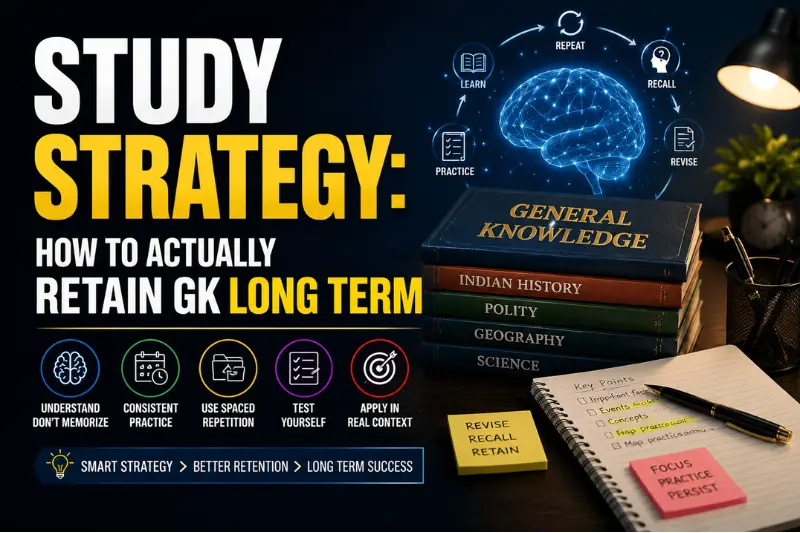
The core problem with how most students study GK: They read through long lists once, feel like they know it, and forget 70% within 48 hours. This is not a motivation problem. It is a retrieval problem. You only lock information into long-term memory by actively retrieving it, not by reading it repeatedly.
Active recall over passive reading. After reading 10 questions, close the page and write down every answer you remember without looking. This single habit triples retention compared to rereading. It feels harder, which is exactly the point.
Spaced repetition. Review new GK questions 1 day after first reading, then again 3 days later, then 7 days later, then 21 days later. After four reviews using this spacing, most facts stay accessible for months without further effort.
Connect facts to context. Knowing that the Tropic of Cancer passes through 8 states is not enough. Connect it: those states receive more direct sunlight, which affects their agricultural calendar, crop types, and climate. Connected facts are remembered far longer than isolated ones.
Subject rotation schedule:
| Day | GK Focus |
|---|---|
| Monday | Indian History |
| Tuesday | Science and Technology |
| Wednesday | Geography (India and World) |
| Thursday | Polity and Constitution |
| Friday | Economy and Current Affairs |
| Saturday | Sports, Awards, Art and Culture |
| Sunday | Full revision and mock test |
Daily time commitment: 30 minutes is enough if used correctly. Ten minutes on new questions, ten minutes revising yesterday’s category, and ten minutes on one current affairs topic.
Wrong answers are your most valuable resource. Every question you get wrong is telling you exactly what to revise. Keep a dedicated error log, review it weekly, and weight your revision toward your weak categories.
FAQs on GK Questions
What is the best way to improve GK for competitive exams?
Read 15 to 20 GK questions daily with their explanations, not just the answers. Revise using spaced repetition, follow current affairs through a trusted source, and take weekly mock tests where you time yourself under exam conditions.
How many GK questions appear in UPSC Prelims?
The General Studies Paper 1 of UPSC Prelims contains 100 multiple-choice questions. GS covers History, Geography, Polity, Economy, Environment, Science, and Current Affairs across these 100 questions.
Are GK questions the same for all competitive exams?
Core topics overlap, but the depth and focus differ significantly. SSC exams test more static GK. Banking exams emphasise financial awareness and current affairs. UPSC and NDA tests analytical understanding and expect you to connect facts rather than simply recall them.
What is the difference between static GK and current affairs?
Static GK refers to facts that do not change, such as rivers, mountains, historical events, and constitutional articles. Current affairs refers to recent developments, including new government schemes, appointments, awards, treaties, and scientific discoveries.
Which topics are most important for SSC CGL GK?
Modern Indian History, Indian Polity, Geography (both Indian and World), Science basics across Physics, Chemistry, and Biology, and current affairs from the past 6 to 12 months.
Are there memory tricks for GK?
Yes. For the 8 states through which the Tropic of Cancer passes, the mnemonic is: Gar Raja Madhav Chhath Jhare, Pashchim Tripura Mile (Gujarat, Rajasthan, Madhya Pradesh, Chhattisgarh, Jharkhand, West Bengal, Tripura, Mizoram). For science, connecting facts to real-world applications (why tungsten is used in bulbs, why the sky is blue) works far better than raw memorisation.
How often is this page updated?
This page is updated monthly with fresh current affairs GK questions verified against official sources, making it a reliable resource for exam preparation throughout 2026.
YOU MAY ALSO LIKE:
15 Plus Leave Applications for School
Good Excuses to Miss Work on Short Notice
LKG Full Form Explained – A Parent’s Simple Guide to Meaning


