


If you’ve ever typed “have been waiting” and second-guessed yourself, in an Exam, an essay, or just everyday writing, you’re not alone. This tense trips up even advanced English learners, mostly because nobody explains why it works the way it does.
This guide fixes that. You’ll find the formula, real-life examples, the stative verb rule everyone gets wrong, and five exercises with answers. No jargon. No filler.
Table of Contents
What Is the Present Perfect Continuous Tense?
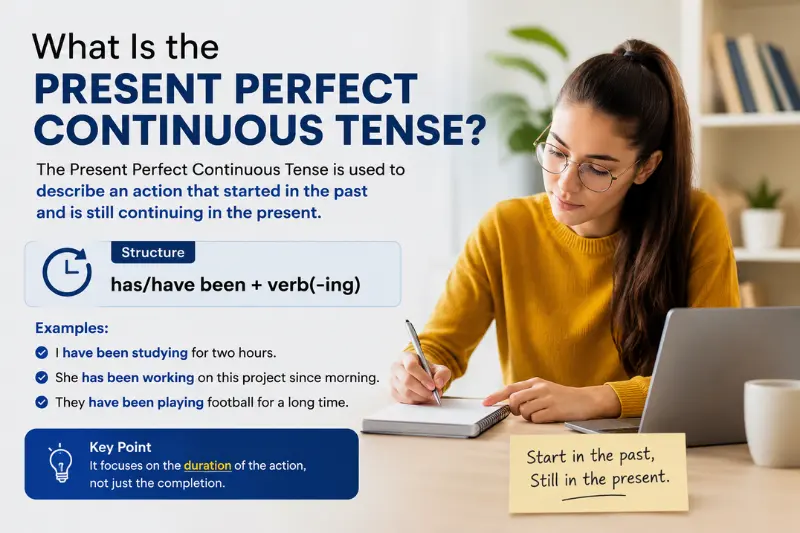
The present perfect continuous tense describes an action that started in the past and is still going on or one that just finished but left a visible result.
It sits between the past and the present. The action began before now, and you can still see or feel its effects.
Example: “I have been studying English for three years.”
That means: I started three years ago. I’m still studying now.
You’ll also hear it called the present perfect progressive tense. Same thing, different name.
The Formula (And How to Remember It)
Subject + have/has + been + verb(-ing)
| Subject | Helping Verbs | Main Verb |
|---|---|---|
| I / You / We / They | have been | working / eating / studying |
| He / She / It | has been | working / eating / studying |
The only rule you need:
- “have been” goes with I, you, we, they
- “has been” goes with he, she, it, and names (Sara, the team, the dog)
The Three-Carriage Train – a memory trick that actually works:
Think of every sentence as a train with three carriages that must all connect:
Carriage 1: Have/Has , Carriage 2: Been , Carriage 3: Verb-ING
She has been working all night. (correct) She has working all night. (missing “been” , train breaks) She has been work all night. (missing “-ing” , train breaks)
Four Sentence Types at a Glance
| Type | Structure | Example |
|---|---|---|
| Positive | Subject + have/has + been + verb-ing | She has been cooking all morning. |
| Negative | Subject + have/has + not + been + verb-ing | She has not been cooking all morning. |
| Yes/No Question | Have/Has + subject + been + verb-ing? | Has she been cooking all morning? |
| WH- Question | WH-word + have/has + subject + been + verb-ing? | How long has she been cooking? |
How it sounds in everyday speech:
- I have been — I’ve been
- He has been — He’s been
- They have not been — They haven’t been
- She has not been — She hasn’t been
When Do You Actually Use It? (3 Situations)
1. The Action Started in the Past and Is Still Happening
“They have been building the new bridge for six months.” “She has been learning French since last year.” “I have been waiting here for forty minutes.”
2. The Action Just Stopped – But You Can See the Result
“You look tired. Have you been running?” “The floor is wet because it has been raining.” “Her eyes are red. She has been crying.”
You’re not saying the action is happening right now – you’re saying the effect is still there.
3. Temporary or Repeated Actions Happening Around Now
“He has been going to the gym a lot lately.” “I have been taking the bus this week because my car is broken.” “She has been feeling better recently.”
“For” vs. “Since” – Finally Explained Clearly
This is one of the most searched grammar questions, and most guides barely touch it.
| Word | Use With | Examples |
|---|---|---|
| For | A length of time | for two hours, for a week, for six months, for years |
| Since | A specific moment in time | since Monday, since 2019, since this morning, since I was a child |
Side by side:
“I have been studying for three hours.” (how long?) “I have been studying since 7 PM.” (starting from when?)
One test that always works: Can you replace it with “a period of”?
“I’ve been studying a period of three hours” – yes. Use for. “I’ve been studying a period of 7 PM” – no. Use since.
50+ Present Perfect Continuous Examples by Category
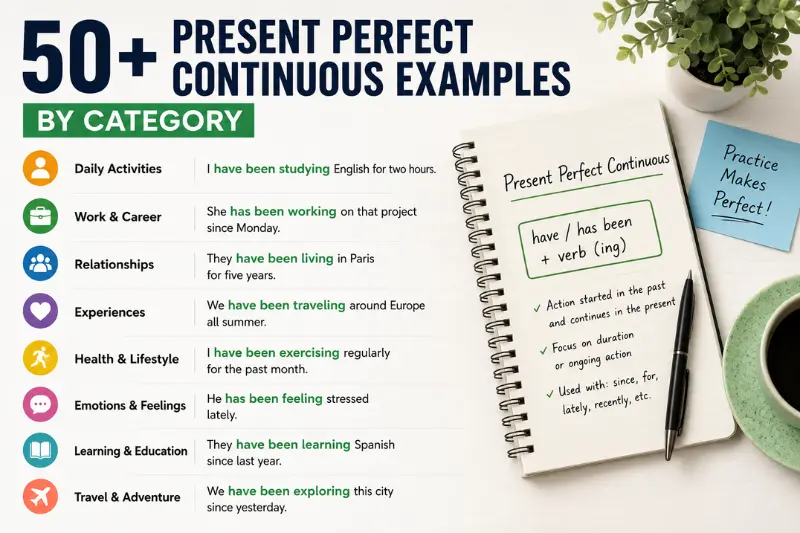
Everyday Life
- I have been cooking dinner for the past hour.
- She has been reading that novel all afternoon.
- We have been watching the same series for weeks.
- He has been sleeping since noon.
- They have been arguing about the same thing all day.
- The baby has been crying for twenty minutes.
- I have been trying to fix this lamp since morning.
- My sister has been baking cookies since 3 PM.
- The neighbors have been playing loud music all evening.
- He has been cleaning the house since he got home.
School and Study
- She has been studying for her exams since last Monday.
- I have been working on this assignment for four hours.
- They have been attending online classes since January.
- He has been practicing his speech all week.
- We have been learning grammar rules since the start of term.
- The teacher has been explaining this topic for thirty minutes.
- She has been reading about history since she was a child.
- I have been revising my notes since yesterday.
- They have been doing group projects for the past month.
- He has been struggling with mathematics for a long time.
Work and Career
- She has been working at this company for five years.
- He has been managing the sales team since last quarter.
- They have been negotiating the contract for two weeks.
- I have been in back-to-back meetings all morning.
- The engineers have been testing the software since Tuesday.
- She has been applying for jobs since she graduated.
- He has been running this business for over a decade.
- We have been working on the project proposal all week.
- The team has been developing the new app for six months.
- She has been training new employees since the branch opened.
Weather and Nature
- It has been raining since yesterday afternoon.
- The river has been rising since the storm started.
- The sun has been shining brightly all morning.
- It has been snowing for hours.
- The wind has been blowing strongly all day.
Health and Emotions
- She has been feeling unwell since last night.
- He has been taking medication for two weeks.
- I have been struggling with back pain for months.
- They have been feeling anxious about the results.
- She has been smiling all day — she must have good news.
Travel and Activities
- We have been traveling across Europe for the past three weeks.
- He has been hiking every weekend since summer began.
- She has been visiting her grandmother every Sunday.
- They have been exploring the city since they arrived.
- I have been taking photographs since we left the hotel.
Technology and Habits
- He has been using this laptop for six years.
- She has been scrolling through social media for an hour.
- I have been listening to the same playlist all week.
- They have been streaming movies since last night.
- She has been learning to code for the past few months.
Result Still Visible (No Time Expression Needed)
- Someone has been eating my snacks — the bag is nearly empty.
- She looks exhausted. She has been working non-stop.
- The kids are muddy. They have been playing in the garden.
- His voice is hoarse. He has been singing all afternoon.
- The office smells of coffee — someone has been brewing it all morning.
What It Sounds Like in Real Conversation
At the office:
A: “You look stressed. What’s going on?” B: “I’ve been dealing with client complaints all morning.” A: “How long have you been working here now?” B: “Three years, and I’ve never had a week this bad.”
Between friends:
A: “Why are your eyes so red?” B: “I’ve been staring at my screen for five hours. I’ve been editing my thesis.” A: “Have you been sleeping properly?” B: “Not really. I’ve been staying up late all week.”
At home:
A: “Something smells amazing.” B: “Mum has been cooking since this morning. She’s been making your favourite dish.” A: “How long has she been at it?” B: “About three hours now.”
Present Perfect Continuous vs. Present Perfect vs. Present Continuous
| Present Continuous | Present Perfect | Present Perfect Continuous | |
|---|---|---|---|
| Formula | is/am/are + verb-ing | have/has + past participle | have/has + been + verb-ing |
| Focus | Happening right now | Completed action or result | Duration or ongoing action |
| Time words | now, at the moment | already, just, yet, ever | for, since, lately, how long |
| Example | I am eating lunch. | I have eaten lunch. | I have been eating lunch for 20 minutes. |
The key difference between present perfect and present perfect continuous:
“I have written three emails.” – three emails are done, focus is on the result. “I have been writing emails all morning.” – focus is on the activity and how long it has been going on.
Stative Verbs: The Mistake That Silently Loses You Marks
Stative verbs describe states, not actions. You cannot use them in any continuous tense, including this one. Most learners do not realize they are making this mistake.
Common stative verbs to avoid in continuous tenses:
| Category | Verbs |
|---|---|
| Mental states | know, believe, understand, remember, forget, realize, doubt |
| Emotions | love, hate, like, dislike, fear, prefer, want, wish, need |
| Possession | have (own), own, belong, possess, contain |
| Senses | see, hear, smell, taste, feel (as a state) |
| Other | seem, appear, consist, depend, matter, mean, cost, weigh |
Wrong vs. right:
| Incorrect | Correct |
|---|---|
| I have been knowing him for years. | I have known him for years. |
| She has been owning that car since 2018. | She has owned that car since 2018. |
| He has been needing help lately. | He has needed help lately. |
| I have been understanding the lesson. | I have understood the lesson. |
The exception: Some verbs can be either stative or active. When they describe an action rather than a state, they can go into continuous form.
“I have been thinking about your suggestion.” (active mental process, not a static opinion) “He has been having trouble sleeping.” (experiencing, not possessing) “She has been seeing a therapist.” (visiting, not the sense of sight)
Real-World Uses: IELTS, Job Interviews, Professional Emails
IELTS Writing
Using this tense in Task 1 and Task 2 shows the examiner a range of tenses.
“Global temperatures have been rising steadily for the past century.” “Researchers have been studying the effects of social media on teenagers for over a decade.” “Urban populations have been growing at an unprecedented rate since industrialisation.”
Professional Emails
“I have been waiting for a response to my earlier email sent on Monday.” “Our team has been working on the revised proposal and will share it by Friday.” “We have been experiencing technical difficulties with the server since last Thursday.”
Job Interview Answers
“I have been working in digital marketing for four years.” “I have been developing my leadership skills through cross-functional projects.” “I have been managing a team of eight people since last year.”
5 Common Mistakes (And How to Correct Them)
- Mistake 1 — Using a stative verb: Wrong: I have been knowing the answer since yesterday. Right: I have known the answer since yesterday.
- Mistake 2 — Forgetting “been”: Wrong: She has working here for three years. Right: She has been working here for three years.
- Mistake 3 — Mixing up “for” and “since”: Wrong: I have been studying since two hours. Right: I have been studying for two hours.
- Mistake 4 — Using it for permanent facts: Wrong: The Earth has been orbiting the Sun for billions of years. Right: The Earth orbits the Sun.
- Mistake 5 — Wrong helping verb: Wrong: He have been sleeping all morning. Right: He has been sleeping all morning.
5 Practice Exercises (With Answers)
Exercise 1: Fill in the Blanks
Use the present perfect continuous form of the verb in brackets.
- She _______ (read) that book all day.
- They _______ (wait) for the bus for half an hour.
- I _______ (work) on this report since morning.
- He _______ (play) video games for three hours.
- We _______ (plan) the trip for weeks.
- It _______ (rain) since Tuesday.
- The children _______ (play) in the garden all afternoon.
- She _______ (not / feel) well lately.
- _______ you _______ (study) for the exam?
- How long _______ he _______ (live) in this city?
Answers: 1. has been reading 2. have been waiting 3. have been working 4. has been playing 5. have been planning 6. has been raining 7. have been playing 8. has not been feeling 9. Have you been studying 10. has he been living
Exercise 2: Correct the Mistake
Each sentence has one error. Find and fix it.
- I have been know him for a long time.
- She has been worked here since April.
- They have been live in London for six months.
- He has been feeling sick since three days.
- We been studying together all week.
Answers: 1. I have known him (stative verb – use present perfect simple) 2. has been working 3. have been living 4. for three days 5. We have been studying
Exercise 3: Rewrite Using Present Perfect Continuous
- She started learning Spanish two years ago. She is still learning.
- He began working at this firm in 2020. He still works there.
- It started snowing at noon. It is still snowing.
- They started arguing an hour ago. They are still arguing.
- I started feeling dizzy this morning. I still feel dizzy.
Answers: 1. She has been learning Spanish for two years. 2. He has been working at this firm since 2020. 3. It has been snowing since noon. 4. They have been arguing for an hour. 5. I have been feeling dizzy since this morning.
Exercise 4: Choose the Correct Option
- She (has been working / has been work) on the project since Monday.
- They (have been waited / have been waiting) for an hour.
- How long (have / has) he been studying here?
- I (have been knowing / have known) her since school.
- It (has been rained / has been raining) all morning.
Answers: 1. has been working 2. have been waiting 3. has 4. have known 5. has been raining
Exercise 5: Build the Sentence
- Me / cook / since 6 PM
- She / not sleep / well / lately
- You / study / for / three hours?
- The team / work / on the design / all week
- It / snow / since / yesterday
Answers: 1. I have been cooking since 6 PM. 2. She has not been sleeping well lately. 3. Have you been studying for three hours? 4. The team has been working on the design all week. 5. It has been snowing since yesterday.
Quick Reference Table
| Point | What to Remember |
|---|---|
| Formula | Subject + have/has + been + verb-ing |
| “have been” | I, you, we, they |
| “has been” | he, she, it, singular names |
| “for” | duration (for 2 hours, for years) |
| “since” | starting point (since Monday, since 2020) |
| Avoid stative verbs | know, own, love, believe, need, want, etc. |
| Key time words | for, since, lately, recently, all day, how long |
| Negative | have/has + not + been + verb-ing |
| Question | Have/Has + subject + been + verb-ing? |
Frequently Asked Questions
What is the present perfect continuous tense?
It describes an action that started in the past and is still going on now , or one that just stopped but still has a visible effect on the present.
What is the formula?
Subject + have/has + been + verb(-ing). Example: “She has been studying since morning.”
What is the difference between present perfect and present perfect continuous?
Present perfect focuses on a completed result (“I have finished the report”). Present perfect continuous focuses on the duration and ongoing nature of the action (“I have been writing the report all day”).
Can I use stative verbs in this tense?
No. Verbs like know, love, own, and want describe states, not actions. Use present perfect simple instead: “I have known her for years,” not “I have been knowing her.”
What is the difference between “for” and “since”?
“For” goes with a duration: for three hours, for two weeks. “Since” goes with a specific point in time: since Monday, since 2021.
Can I use this tense without a time expression?
Yes. Without a time expression it suggests something has been happening recently. “You look tired — have you been sleeping?” works perfectly well.
Is “present perfect continuous” the same as “present perfect progressive”?
Yes. Both names refer to the same tense. Progressive and continuous are interchangeable terms in English grammar.
How do I form a negative sentence?
Add “not” after have/has: Subject + have/has + not + been + verb-ing. Example: “I have not been sleeping well lately.”
How do I form a question?
Swap the subject and have/has: Have/Has + subject + been + verb-ing? Example: “Have you been waiting long?”
What time expressions are most common with this tense?
For, since, all day, all morning, all week, lately, recently, how long, this week, this month.
YOU MAY ALSO LIKE:
15 Plus Leave Applications for School: Ready to Copy Samples That Get Approved (2026)
Good Excuses to Miss Work on Short Notice – Valid Reasons and What to Say
What Is the Role of Education in Human Capital Formation?
LKG Full Form Explained – A Parent’s Simple Guide to Meaning, Age, Syllabus & Early Learning


